“The film visits the places the book visited, but since the antics of pro-virginity culture were captured on camera this time around, it’s now infinitely more gif-able. From the creepy father-daughter “purity balls” where young women promise their dads that they won’t let anyone’s penis inside of them until God says it’s okay to the fearmongering but charismatic pro-virginity speakers who claim a link between female sexual activity and sterility, parts of the film (like parts of the book) would be hilarious if they weren’t so scary.”
.
From the Queer Blogosphere:
A friend posted this on Facebook. Not sure where it originated. But it’s sooo true!
Not news, but recently came across several really amazing photo albums from International Women’s Day back in March. Nice to see! (click pics to see albums)
Women raise their hands as they shout slogans during a protest on International Women’s Day in Ahmedabad
Lebanese women working at an advertising company in Beirut dress like men and pose for pictures to make a statement about gender inequalities
In Israel
Refusing to go to the back of the bus
Tanya Rosenblit is being hailed by some as the Israeli Rosa Parks. Last week, she got on a bus from the town of Ashdod to Jerusalem. An Ultra-Orthodox man insisted she move to the back of the bus. She refused. The bus was stopped, police were called… Read all about it here.
And here’s another way kowtowing to the Ultra-Orthodox misogyny endangers women’s lives:
Another hot topic causing me distress these days: The fight for equality for gay men under Israel’s surrogacy laws. Grrrrr, talk about a can of worms. I’ve already butted heads with people I usually like and agree with on this. Here’s why.
Most people I know – of liberal leanings – have this kneejerk reaction: Yes! Equality for gays! Enhanced rights and opportunity for parenthood for gay couples! Yay!
Have you figured out what’s missing in this scenario? Yes, indeed – the same person who is being stashed out of site on an increasingly frequent basis: The woman.
Who is providing these surrogacy services? Who is looking out for her interests? Is there even any discussion about it? Any medical, legal, ethical, financial, or psychological standards being adhered to? Or being crafted, if there aren’t any in place?
How many people know what is involved from a health perspective (physical and mental) for the woman providing her body as a service? Versus how many people are jumping in with both feet with accusations of “Homophobia!!” at even the hint that such a discussion should take place?
(And let’s be very clear: no one in the discussion I’m referring to is advocating that heterosexuals should be allowed to this, while homosexuals should not.)
Why is it so easy to ignore the woman?
Here’s some background:
Israel was the first country in the world to legalize surrogacy, in 1996. While some (liberal?) feminists celebrated this as a victory for a woman’s legal freedoms (for example, to enter contracts, and autonomy to determine what to do with her body), other (radical?) feminists immediately classified the practice in the context of a patriarchal society’s attempt to use women’s bodies to further patriarchal ends.
But maybe some more background about Israel and the issue of procreation is needed here.
Israel is unique in its pro-natal attitudes, especially compared to other Western countries, in the sense that having children (Jewish children) is considered an imperative. Not only a cultural imperative, not simply a religious imperative, it is also a political imperative. This is for several reasons:
In the aftermath of the holocaust, many believed that Jews must reproduce to replace the 6 million lost. Others, including the political leadership of the time, viewed child-bearing as a military imperative – women must produce soldiers for the army (first Israeli prime minister Ben-Gurion famously wrote that “Any Jewish woman who, as far as it depends on her, does not bring into the world at least four healthy children is shirking her duty to the nation, like a soldier who evades military service.”). Part of it is traditional – Judaism is family-centric. Part is purely religious – the ultra-orthodox in Israel have a birth rate that is twice that of Muslims, and four times that of secular Jews.
Over the past few decades, one of the most common themes has been the “demographic threat” – if Israel wants to maintain both its identity as a Jewish state and remain a democracy, it simply must maintain a Jewish majority in relation to the Arab population. (Or, for more right-wing sectors, simply “winning out” vs. the Palestinians is the point, without regard to the democratic nature of the country.)
Whatever the reasons, the imperative is deeply ingrained in the culture, which places pressure and socializes people to place child-bearing at the top of their life priorities. It also created a legal and medical system in which parenthood is encouraged and state-supported through:
Reproductive technologies. Israel is the leading country in the world in in-vitro fertilization, leads in development of reproductive technologies, and also provides financial support for the procedures.
(I can (and maybe will) write entirely separate posts about the negative effects this has on women, and how many of the procedures are untested, how low a concern safety is, on the cultural impact on women of being state-sponsored wombs… But alas this post is on another topic which I shall promptly get back to.)
Support of single-parenthood, through various methods including sperm banks (artificial insemination, IVF), adoption (international) and of course —
Surrogacy.
Okay. So now you might be getting an inkling of what parenthood means to Israelis.
And of course, the fight for equality and recognition of LGBT people’s rights to become parents, and creating legal and societal mechanisms for parenthood to be a realistic possibility, is an important one.
So, what’s actually going on?
As I said, Israel legalized surrogacy in 1996, and was the first country to do so. There have been various judicial decisions along the way determining who can do it, where, how… The bottom line is that under the current rules, only heterosexual couples can hire a surrogate to carry a child for them. This can occur either in Israel or abroad. Homosexual couples or single people cannot (as far as I understand it) contract a surrogate in Israel.
Gay couples can hire a surrogate in the US or India, but a court decision last year regarding DNA tests for both fathers has created some hindrance even to this practice.
So recently, a campaign began to change the law – though a Facebook page (in Hebrew) and an Internet petition. This has brought the discussion back to the forefront in both LGBT and feminist circles, as well as to the broader media and legal communities.
Another Facebook page – Gays Against Surrogacy (in Hebrew) – soon followed. As I mentioned before, claims of homophobia quickly surfaced.
And hence my personal frustration:
First of all, the LGBT association – or Aguda – Israel’s main LGBT advocacy group, is strongly supporting this initiative, to the extent of overshadowing just about any other issue. So once again, the interests of a minority of men, who are primarily white, homonormative, and from a socioeconomically advantaged background are taking precedence over, say – teen prostitution in the LGBT community (which is on the rise), teen suicide, transgender rights, AIDS awareness, or a myriad of other LGBT issues. I’m pretty sick of this lack of wider representation. If it’s the white gay men’s association, they should just say so.
And once again, women are being submitted – physically, mentally, financially, and legally – to the needs of men (or at least to the patriarchal priorities of this society).
I want to support parenthood rights for gays. I *do* support all brands of equality. I cannot, by any stretch, get behind yet another initiative that subordinates women to anyone else’s agenda.
~*~
Here are some resources on the topic for anyone who wants to read more:
“There is plenty of scientific knowledge and understanding of health risks as a result of hormone treatments associated with in vitro fertilization (IVF). This raises questions about the widespread use of this procedure, especially when women are exposed to these health risks not for themselves but to conform to other people’s desires. Establishing surrogacy as a prevalent, accepted way of bringing children into the world entails significant risks to the surrogate mother herself, to the child, and to society”
Google Baby – a documentary on surrogate mothers in India: Focused on a clinic in rural Anand where peasant women give birth to babies ordered over the Internet through an Israeli “pregnancy producer.” Western hetero and gay prospective parents click on the sperm and eggs of their choice, enter credit card details, and later travel to Anand to receive the newborn they couldn’t or wouldn’t conceive themselves.
Will Israeli Court Decision on Surrogacy Bring Changes for Gay Couples? Blog post, The Sisterhood “In principle, I agree completely with the Court’s decision in favor of the petitioner who wants a fourth child. But there is also the reality of scarce resources to consider. I would have no issue with the Court’s decision if surrogacy were not a highly limited and regulated commodity in Israel.”
A commodity, indeed.
I haven’t written as much as I planned in the past two weeks. I had a (too-long) list of topics to cover: Princess Culture, Why/how women are not taught to say NO, “Sitting at the table”, teaching girls to be smart rather than pretty, and more.
But while my sort of intro-level feminist posts were boiling in my head, things were happening around me that I just couldn’t deal with, and which affected my ability to focus on my planned posts. I live in Tel Aviv, Israel. I’m not sure how much coverage there is internationally about what’s been going on here… The international press is famously inaccurate and biased (in all sorts of directions) in covering this region. So I’ll give a snapshot.
The (very) short version is that there are two related and very frightening trends happening here:
The first is a growing wave of nationalism, which includes increasing violence towards minorities, a surge of anti-democratic legislation designed to silence protest and opposition, curtail the activities of human rights groups, promote settlement in West Bank territories, giving enhanced rights to orthodox Jewish minorities at the expense of, well, everyone else…
The second is an increasing exclusionary and discriminatory attitude towards women. This has manifested in several ways, including government support for segregated buses and public transportation in Jerusalem, the removal of women from public images (such as billboards and posters) in response to orthodox pressure, separate sidewalks for men and women (as a matter of fact – even when the supreme court ordered this to be stopped, the municipality refused, and when the one woman on the city council protested this, she was fired)… Male soldiers walked out of a military ceremony because women were singing, behavior they were not punished for, and as a matter of fact they seem to be getting the support of the powers-that-be, meaning that women will be further silenced and segregated in the army. (One leading rabbi says soldiers should “choose death” rather than listen to women sing). Women are being excluded from judiciary committees, and several leading female news professionals are being fired from their jobs – based on age and appearance (keep in mind the female presence in Israeli news is minimal to begin with). Teachers’ faces are blotted out of educational campaigns. And more.
An ad in its original form (right), and cropped for publication in Jerusalem
(Well, there are also economic trends, with the government passing laws that put more money into the pockets of cartels/tycoons, and take more away from the rest of us. And more stuff. But how much can I possibly focus on? Or deal with, without just keeling over??)
I haven’t been covering any of this in my blog, keeping my activism to my local community and Facebook. Because I didn’t feel I could do the topic(s) justice in the amount of time I have to write. But the fact that I got as overwhelmed as I did made me realize that if I didn’t write something about it, I would never get back to my personal blog agenda – which also includes queer/LGBT topics, which are falling ever-further behind.
So for now, I’d like to share some of the actions that have come (primarily from women) in response to some of these anti-woman trends. (read more here)
1. Poster campaign:
Following the literal erasure of women from public advertising (including, by the way, from the entire campaign for organ donation), several women conceived a campaign consisting of a photo shoot of women, and printing posters that people could hang from their windows or balconies, creating a female presence in Jerusalem in spite of the religious pressure for erasure.
The campaign’s taglines were: Not Censored and Bringing Women Back to the Public Spaces
A public singing event was coordinated in four different cities (including Jerusalem) where women declared in the most direct manner possible: We will not be silenced!
The Jewish proscription against women singing is based on the idea of “Kol B’Isha Erva” or, “the voice of a woman is nakedness”, where the word for nakedness actually means literally “the pubic region”, and is used for “lewdness”. Therefore, immodest/impure/prohibited. The protest event was promoted as “This is not what “pubic” looks like”, and subtitled “Don’t Stop Singing!”.
(I looked but couldn’t find myself in any of the photos…)
“Mute Protest” today, in Tel Aviv and Jerusalem (FB event is in Hebrew. Here is the Occupy Israel protest post. ) (The idea being, of course, that women’s voices are being silenced. Neubach is one of a very few women in journalism who actually has a POV)
Petitions: There are several. Here’s one (in Hebrew).
I’m not sure when was the first time I heard of this trend of princess classes: Little girls in a sort of etiquette class teaching them how to wear tiaras, curtsy, and sip tea. I do remember being pretty horrified by the idea, but not surprised. It isn’t a far cry from the type of dolling-up done to little girls on the pageant circuit.
I remember mothers and daughters giggling at the camera, wondering what could possibly be wrong with this, doesn’t every little girl dream of being a princess? Of catching a prince?
(And this year’s British royal wedding certainly did nothing to quell the wave: even Israel, with no history of aristocracy or royalty, nor even a concept of rudimentary etiquette, offered a Young & Beautiful Princess Summer Camp following that romance of the century.)
This is what I think princess-iness teaches girls. This picture has quickly become a Facebook meme, and I love it:
He: You know what X did to Y on their business trip? He took him to a gay bar!
I: “Did to” him?
He: You know what I mean!
She: I LOVE going to gay bars!
He: Of course you do, guys don’t hit on you there. It’s different for me. Of course I wouldn’t be caught dead at a gay bar…
I: Why not?
He: Because guys might hit on me.
I: So? You just say no.
He: Seriously.
I: Seriously, I really don’t see the difference if a guy hits on you or on me.
He: It’s natural for guys to hit on you.
I: um… Where to start. So the problem with gays is that they are unnatural? I’m sure X appreciates that.
He: I didn’t say that!
I: And when guys hit on me… It’s because they KNOW I’m interested? Or it doesn’t matter if I am, because it’s natural for THEM?
He: It’s natural, it’s the way things work.
I: Just so I get this right — my level of interest is irrelevant. Yours is paramount. Why the double standard?
He: Just shut up already! I don’t have double standards. It isn’t the same!
I: So just by going out, I’m available for hitting on?
He: You know what? You’re right. No man should ever hit on YOU (guffaw).
I: Nice.
He: If you don’t want to get hit on, stay home!
I: Allow me to summarize: Being gay is unnatural, and if a gay guy makes a pass at you, it’s an outrageous and traumatic thing to have happen to you…
He: Yes…
I: I, on the other hand, am supposed to be flattered if a guy makes a pass at me?
He: Yes
I: Even if I’m not interested in him? Or in guys? Or am in a relationship?
He: Well, just say no.
I: And if, say, 10 guys make passes at me, that just means I’m popular, right?
He: …
I: And what if it’s a hundred guys? When does it become legitimate for me to object to this “natural” behavior?
He: Stop putting words in my mouth! You’re making me out to be a homophobe!
I: I’m pretty sure you’re doing a good job of making yourself out to be a homophobe.
.
.
.
I have a confession to make: I LOVE watching What Not to Wear. The Trinny & Susannah shows, of course. I hear there’s a US version. I hear there’s a new UK version. Not those. I love Trinny and Susannah.
When I watch the program, I sometimes question myself — how does this fit with my feminist beliefs? With my core values regarding women, how women are perceived in our culture? The pressures on women? Women’s body image? Sense of self worth?
The answer is that sometimes I feel great about it, and sometimes I feel wrong. And of course when I feel wrong about stuff it tends to piss me off. I kind of like to shout at the TV screen as if Trinny will hear me, and say, “Oh yeah, you have a point”.
I watched a chapter of Trinny & Susannah Take On Israel last night. I did a bit of shouting. I also got a bit teary-eyed. And what’s the point of having a blog if I can’t write about it?
Here’s What T&S Get Right
They believe women are beautiful. Women of all shapes and sizes. Of all ages. Of all races.
They do a good job of drilling down into what is upsetting women about their bodies, about the image they project, and tackling that.
They are very body-positive. They are not shy about discussing and showing their own bodies (and avoiding it being in an overly sexualized, prurient way). And they encourage (force?) the women they work with to really look at their own bodies. Generally women who are avoiding doing just that, which is a symptom of self-loathing, or at least a lack of self-acceptance.
They don’t promote SKINNY. More about playing the beauty game further down, but they aren’t part of the mythological-beauty-promoting industry. IMO. They celebrate the female form. They love curves — breasts, bums, legs… And they also love women with fewer curves. I love that.
They are honest about the female form including its “flaws”. Honest is good — women change when they age, when they have children, when they go through menopause… now it just depends what you do with that honesty.
They are outspoken women with a point of view. They believe in something, and they make it happen. They are not in anyone’s shadow. Go T&S!
Here’s What T&S Get Wrong
Notwithstanding what I wrote above, T&S *do* engage in playing the beauty game. I disagree with criticisms that have been made of them that they make women feel bad unless they fit the beauty concept prevalent in western culture. But I do think they promote that concept of beauty — with their own celebratory contributions I described above — without ever really questioning it.
Leading to the fact that I often think T&S are overly rigid in their viewpoints, probably to the detriment of some of the women they are trying to help, and certainly upsetting me from a feminist perspective. To wit:
Not allowing for different gender identities and perspectives.Two examples just from the recent Israeli series:
The first was when they made-over a lesbian couple. The femme member of that pair — no problem. But her butch partner… Major problem. Even though they said some of the right things about her maintaining her identity, they pretty much forced her into makeup she will never wear again, and into sparkly fabrics she didn’t want, albeit a sparkly vest. I didn’t feel this was a shining moment for them.
The second was the makeover of a self-professed feminist. She did express a desire for her clothes to express more of her femininity, but she was very adamant that she didn’t want it to spill over into anything objectifying or sexualized. The dress+leggings they picked were probably okay (though overly dressy, see next item down). But Trinny would NOT let up until the woman agreed to wear very high heels. Not respectful of a desire to align beauty with comfort — from a principled perspective as well as a practical lifestyle perspective.
Not allowing for cultural differences.T&S come brimming with well-defined ideas of how women should dress. The fact that they have a POV is laudable. But if they dress an Arab woman in Jerusalem as if she were an Anglo in London, well — I’m not sure how respectful, or effective, that is. I get wanting to bring on the changes they are promoting. But when they dressed a religious girl who didn’t want to wear trousers or a short skirt, the pressure came on again. They are a force to be reckoned with, and I’m not sure they are doing anyone a service by forcing the issue in these cases.
One major comment T&S came away from Israel with is that Israeli women should dress up more, and wear more color. I hear them. I feel them. I really do. But failing to understand that a shiny dress would probably only be worn at a wedding in this country, and even then — not at EVERY type of wedding — is not serving the woman they are dressing. If they really want to make an impact, they should find clothing that is still within the gamut a woman would be comfortable with given the social environment, and that also meets their exacting standards. It CAN be done.
Are they overly touchy-feely? Mixed feelings about this one. I find Susannah’s admiration of the female form to be sincere, and her enthusiasm infectious. I’m just not sure every one of those women really wants her breasts grabbed. I’m wondering if participants sign a breast-grabbing release form before the show is filmed, to avoid sexual assault claims.
That’s the gist of it. I don’t find myself offended by the mere focus on beauty and clothing, given that I am a self-defined femme myself, and I don’t find it un-feminist to wear heels or lipstick. What I do object to is having a cultural dictate that says I am worth less if I don’t. I’m not certain that T&S are friends to this value of mine. But I guess I forgive them because of the many women they DO help find confidence and self love. (Like the girl on the show who developed early, and was caught up in the skinny model image of beauty, so she wouldn’t wear anything but a baggy hoodie, to hide her curvy self. Enabling her to celebrate her form, come out of her shell, so to speak… I think that’s a wonderful thing to do.)
And then, I have learned a lot from them about WHAT NOT TO WEAR. I am always extremely appreciative of those I can learn from.
I’m reading a LOT of blogs lately, trying to read up on topics I want to write about, and then, just surfing through things that catch my interest. Sometimes I learn new things. Sometimes I come across stuff I know, but with a new twist, or presented in a way that makes me want to cheer and applaud the writer.
When you approach me in public, you are Schrödinger’s Rapist. You may or may not be a man who would commit rape. I won’t know for sure unless you start sexually assaulting me. I can’t see inside your head, and I don’t know your intentions. If you expect me to trust you—to accept you at face value as a nice sort of guy—you are not only failing to respect my reasonable caution, you are being cavalier about my personal safety.
Continuing the topic of NICE, being taught to be a nice girl, to not be a nice guy… If you are male and reading this you might be thinking, “but, hey, I *am* a nice guy!”
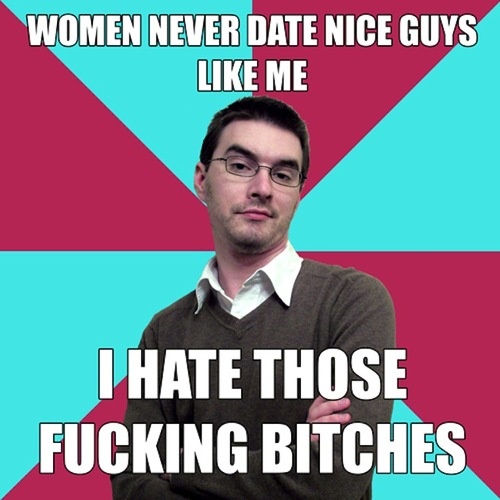
Maybe so. And maybe… Let me introduce you to a term well-known in feminist circles, maybe not-so-much elsewhere: NICE GUYS™.
Nice Guys™: The “™” marks the difference between men who are genuinely nice people and men with entitlement issues who wail “but I’m a nice guy!”. There are two types, which often overlap in one individual:
a guy who believes that the simple act of being decent means that the universe owes him a girlfriend [more from Jeff FeckeatShakesville]
men who are looking to date a woman with the appearance of a supermodel, and yet they continually whine about how “women don’t like nice guys – they only want good-looking assholes
And there’s an entire rant (and response) repository on HeartlessBitches.com. It’s great, read it when you have time to get sucked in… Here’s how they introduce the topic:
All too often we hear self-professed “Nice Guys” complaining about why they can’t get a date, and whining that women just want to date jerks, etc. etc. The truth of the matter is that there are genuinely caring, compassionate, decent, fun guys out there who have NO TROUBLE meeting people, getting dates, and having relationships.
Unfortunately, many of the guys who DO have trouble, insist that women don’t want them because they are “too Nice”. These people who call themselves “Nice Guys” can’t see that THEIR OWN behavior is the problem. …. acting in a manipulative, patronizing or obsequious fashion, these guys sabotage themselves and often blame “all women” for their misfortunes.
To me, the key is the “manipulative, patronizing, or obsequious” part.
What does this really mean?
It means that there are a LOT of guys out there who are “nice” to women, but aren’t really treating women as persons. Rather, they treat women as sexual objects, something to be conquered, the PRIZE for being A NICE GUY. This is simply not genuine. And not really NICE.
These are the guys that comment on your Facebook post, start a conversation with you that actually seems to be intellectual, but within a short time, will shift to trying to pick you up. NOT because there was mutual interest percolating – of course that can happen (but let’s be honest, it doesn’t happen every other day!) – but because they would make that type of offer to any woman they have a dialogue with. With the hope that eventually one will say yes. There may be a modicum of real interest in the original topic, but eventually objectification rears its ugly head.
These are the guys who befriend you, maybe even after asking you out and being rejected, who eventually try for “comfort” sex after you break up with the guy you are dating, or go for pity sex, or FWB status (notice how many times that happens when you’re feeling vulnerable). These guys may spend a really long time being your friend – even years! – but in the end, if they feel anything like “I listened to her, I was nice to her, I did this and that for her, tried to give her what she wanted… but it didn’t WORK!” Whoa – didn’t work? This means at some fundamental level, even if at times they really acted as friend, at the base of it was a desire/expectation that they would GET YOU. Which again, reduces you to a thing. To be gotten.
These are the guys who ask you out nicely, but when you say “no”, they try to convince you (Why not? Do you have a boyfriend? What do you have to lose? ) which in its most benign form is disrespectful of your stated desire, and in its more malignant forms turns into actual manipulations, trying to make you feel guilty, or even worse – preying on your insecurities. If they are good at being NICE GUYS™, they will do all of that very “nicely”. But then there are the ones who then respond with anger – all women are really bitches, women *say* they want a nice guy but they really only like assholes, etc. Think about the ENTITLEMENT reeking from this – if I’m a nice guy, I deserve to HAVE YOU. The corollary to this is, you really don’t have the basic right to refuse them.
There are the guys who think they are being NICE to you because they are complimenting you on your looks. Nope, no objectification THERE.
As an aside (well not really an aside, more like an extreme result of the above that deserves its own post), when manipulation of the types described above does “work” and leads to sex, the woman involved often feels extremely violated. There is a lot of discussion of whether this qualifies as rape, and it’s a worthy topic, just not the one I’m discussing today. So I will avoid definition of this behavior as rape in any criminal-code sense of the word, but will say this: if a woman FEELS raped (used, abused, violated… pick your negative term) after being with you, how NICE does that really make you? Hmmm, not so nice.
If you read any of the threads I’ve cited, you will see many, MANY examples of nice guys™ responding. It’s amazing how easy they are to spot once you know what you’re looking for. For example, they are patronizing, and they lack the ability to take responsibility. They come into the discussion oozing sympathy, (look what a nice guy I am!!), but inevitably turn it (whatever the issue is) on the women. Like a guy who responded to a thread on women saying NO (yes, another future topic), who started out being sympathetic to women feeling harassed, but eventually made statements like women who say no angrily probably do that because of prior trauma (like that’s the only reason they might get mad at YOU) or having in the past “failed to set adequate boundaries” (yup, it’s THEIR fault they got harassed!).
Or the one who complained that nice guys like him spend years listening/being the shoulder to cry on/helping move house… And the girls “never respond in kind, physically”. Eww.
Et cetera, et cetera.
So there we have it. Another example of that pesky word that gives me such a creepy feeling
A recurring theme in posts about sexual harassment of women in the public space is how women often feel silenced at the moment of confrontation.
When I recently commented about this in a Facebook thread, a couple of things came up. One, the original poster said that some responses might be difficult for her to muster, and also that she only found the strength to speak out as she does after reading numerous, repeated commentaries decrying this behavior by men. Repeated. So the first thing that came to me was, of course, that we do, indeed, need another post on the topic. Good thing I started a blog.
The second thing was my response – how women are socialized to be NICE. How we’re worried about what even this guy invading our space or body will think of us. How we are trained to avoid confrontation. This is something I think about a lot. I’m not reinventing the wheel, but I do want to cover some of my impressions about NICE.
***********************************************
I don’t think I was particularly taught to be nice. Then again, I wasn’t really “taught” very much, having grown up with a violent, unstable, neglectful home life. The main way I survived my nightmare childhood relatively intact was by never giving in. Though my parents could cow me through violence and manipulation, I never gave in mentally, in the sense that I never conceded that they were right. Only that they had power over me. So I ended up a fairly confrontational person. I’m not likely to fear any confrontations I might face as an adult (say from some creep touching me in line) given my long and thorough training. And confrontational — is not NICE. But it does give me the ability to not conform.
And I don’t.
As a result, I have been called all kinds of things by all kinds of people: An “unnatural woman” because I choose not to have children; My ex-husband wanted me to be “more wifely”; People at my (very normative) workplace whisper about me because of my queer and feminist activism. The list goes on.
Which doesn’t mean that I was unaffected by the role models, imagery and standards of my time: From Nancy Drew to Barbie to Samantha Stevens, to Disney princesses… Gender-based role assignments, such as that women could be teachers, secretaries, nurses, ballerinas, or flight attendants (‘scuze me, stewardesses), and must aspire to wifedom and motherhood and a showcase home… While men could/should aspire to be doctors, lawyers, accountants, president, architects, pilots, astronauts, or anything they damn well pleased (except for teacher, secretary, nurse or ballerina). That there was a right way to be a woman and a wrong way: And the right way was to be pure, to be ladylike, to be pleasing… To be NICE.
Of course, being nice was a completely feminine domain. When I was younger, I agreed with my then best-friend that we didn’t want a “nice guy”. Ick. That would be boring. We wanted someone who knew how to strut, who knew what he was worth, who could take control, who would provide excitement. Who was MANLY. We, on the other hand, would bat our lashes, and smile a lot. Unlike the boys who had their pride and honor, we would easily apologize, accommodate, adapt.
And the boys, not only were they not taught to be NICE, they were taught to go out and crush the opposition. They were taught to WIN. They knew that “nice guys finish last” and of course, that nice guys don’t get the girl. They knew who did — the soldier, the pilot, the leader, the tough guy, the bad boy, the Casanova. Their mothers beamed with pride as they practiced trampling the weak and taking what they wanted.
When I experienced sexual harassment and even when I was raped, it never occurred to me to tell anyone, to complain; that there might be something I could do about it (in truth, there probably wasn’t). It was something to put in a drawer and move on from. And I still had to be NICE to the men who treated me that way.
The bottom line is that I if you look at the dictionary definition of NICE it is not a bad thing – it’s a quality more people could use an increased dose of. But the way it’s used – to tell girls how to be proper females, and as an example of what men should NOT be – I have a huge aversion to the word.
And I do not really consider myself a NICE person.
However, not being “nice” has not make me: unkind, ungenerous, uncaring, inconsiderate, unsupportive, a bad listener, or lacking any of a range of other positive qualities. (Not saying I don’t have my faults 🙂 Nor that I am never “nice”. )
And another note: My best friend in law school told me in response to the not wanting a nice guy thing, “But of course I want a nice guy. Who doesn’t want their partner to be nice to them?” Duh. Yep, that was a wake up call.
And yet, the word NICE still makes me cringe, a bit. I think it’s good (desirable! essential!!) to teach your children to be courteous, to be considerate, to be contributing members of their communities, and so on. But every time I hear a girl being told to “be nice”, my stomach turns over. It incorporates into that one little word a whole universe of harmful behaviors socialized into girls/women, that I really REALLY want rid of. I want us to teach girls to say no. To know what they want, and believe they deserve it. To expect others to respect those wants. Not to cave in to bullying or manipulation. To recognize when they are being manipulated. To know how to effectively protect themselves. To stop apologizing. To stop making excuses for bad behavior by males. The list goes on.
Coming soon:
More on silence in the face of actual or threatened violence, and practical tips on overcoming the “Nice Girl Syndrome”.
I guess this is where I say “welcome to my new blog” and introduce it.
A while back I began to toy with the idea of starting a new blog. My main motivation is that I am very active with my activism on Facebook, and find it a great venue for sharing views and information, but I realized there is no good way on FB to “collect” my favorite posts, links, pictures, comments… Hence this blog. I don’t know what it’s voice will be yet, but right now it’s the extension of what I’m already doing online (you can read the About section if you really want to).
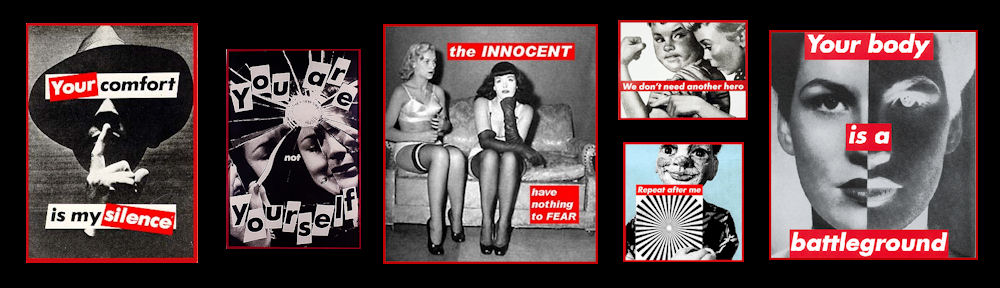
Anyway. While considering what my theme/voice/subject was, I became slightly obsessed with the feminist artist Barbara Kruger (hence the banner above). So this first post is dedicated to her, her artwork, and her messages, which happen to resonate with many things I post about.
 There is far too much going on in the world, and much too little time to write about it…










 Femina Invicta
