The Scariest Shoes of All Time

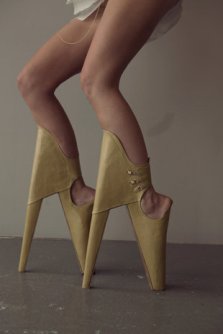
We’ve seen many ugly shoes in our day, but a new pair dubbed “Scary Beautiful” is definitely the most treacherous footwear we’ve ever seen. The massive heels appear backwards on the foot, so the wearers feet point straight down the back, as if in ballet shoes, with their shin leaning against the front “heel” end of the design to balance. The shoes are a collaboration between artist Leanie van der Vyver and Dutch shoe designer René van den Berg, and serve as a commentary on today’s impossible standards of beauty.

The ugliest shoes of all time

Van der Vyver is South African, and recently graduated from the Gerrit Rietveld Academie in Amsterdam. We spotted “Crazy Beautiful” on her website, cargocollective.com, and reached out to her for the inside scoop.

Imelda Marcos’ prized shoe collection is ruined

“After working in fashion for seven years, and therefore being well aware of the manipulation images in fashion suffer for a perfect result, I still compare myself to them and other current beauty ideals,” Van der Vyver told Yahoo! Shine exclusively. “My frustration with my own inability to overcome these feelings of inadequacy was what brought ‘Scary Beautiful’ into fruition. The shoes formed part of my graduation project that was a result of my thesis. The conclusion of my thesis investigation was that people are not satisfied with what they look like, and that perfection, according to the beauty and fashion standards, has reached a climax. Humans are playing God by physically and metaphorically perfecting themselves. Beauty is currently at an all time climax, allowing this project to explore what lies beyond perfection. Scary Beautiful challenges current beauty ideals by inflicting an unexpected new beauty standard.”

A model wearing the Scary Beautiful shoes.
Photo by Lyall Coburn

Unsurprisingly, Van der Vyver’s “Scary Beautiful” shoes were nominated for a design prize at Gerrit Rietveld Academie. Jury members Barbara Visser, visual artist and Xander Karskens, and curator of De Hallen had this to say about the shoes:

“The object created by Leanie expands the concept of a shoe into multiple new meanings. The beautifully made leather object is accompanied by a video registration of a girl wearing it. One observes the design forcing the wearer to develop a new way of walking, leaning forward while refining a painfully fragile balance. The jury applauds the way aesthetics, ergonomics and prosthesis merge into an awkward choreography. The craftsmanship and strong conceptual way of designing also show in another work, a ceramic tea set in which reference is made to a building in South Africa. Leanie succeeds in translating political consciousness into form and is considered by the jury to be a meaningful future designer.”
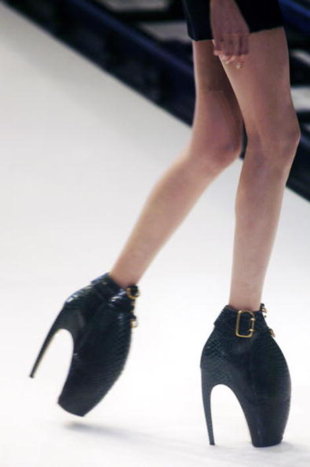
Alexander McQueen’s spring 2010 Armadillo heels.
Photo by Antonio de Moraes Barros Filho/Getty Images

We find the clip shocking but also oddly moving. The shoes are obviously not practical, but as art they’re intriguing. We can’t help but be reminded of Lady Gaga trying to steady herself in the now-famous Alexander McQueen “Armadillo” heels in her “Bad Romance” music video. Major models like Abbey Lee Kershaw, Natasha Poly, and Sasha Pivovarova reportedly refused to wear the 12-inch McQueen heels out of fear, and were cut from the designer’s spring 2010 fashion show. In comparison, the “Scary Beautiful” shoes make the “Armadillo” heels look like sneakers, but we had a feeling the always-outdoing-herself Lady Gaga would give them a spin one day. Sure enough, Van der Vyver confirmed our suspicions.

“Yes, on request I did actually send them to Studio Formichetti for a Lady Gaga music video, but I could not get confirmation whether she actually used them,” Van der Vyver told us. “I did not charge for her to possibly use them. I would love to sell them to a gallery.”

We’re holding out for the “Scary Beautiful” shoes to appear in an upcoming Lady Gaga music video, but until then Van der Vyver is back home in Cape Town starting her own studio where she’ll continue investigating fashion and beauty. We’re anticipating her next creation.

Check out a video below of a model walking verrry slowly in the “Scary Beautiful” shoes.
via The Scariest Shoes of All Time | How To – Yahoo! Shine.

Tribe of Women

ASGARDA
Amazons of the Ukraine

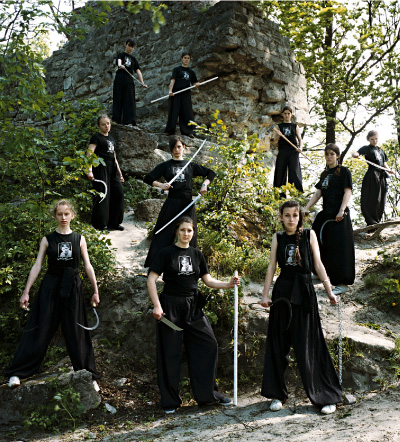
In the Ukraine, a country where females are victims of sexual trafficking and gender oppression, a new tribe of empowered women is emerging. Calling themselves the “Asgarda”, the women seek complete autonomy from men. Residing in the Carpathian Mountains, the tribe is comprised of 150 women of varying ages, primarily students, led by 30 year-old Katerina Tarnouska. Reviving the tribal traditions of the Scythian Amazons of ancient Greek mythology, the Asgarda train in martial arts, taught by former Soviet karate master, Volodymyr Stepanovytch, and learn life skills and sciences in order to become ideal women. Little physical documentation existed on the tribe, until recently, when renowned French photographer, Guillaume Herbaut, met the Asgarda back in 2004 in the midst of the Orange Revolution.

via Asgarda | PLANET°.

Google Cultural Institute Launched Today

,,,,,, 

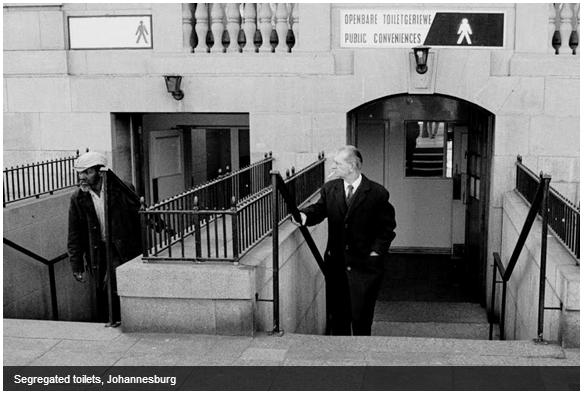
apartheid signs – Google Cultural Institute.

The Google Cultural Institute went live today — in cooperation with museums and cultural institutions, the site covers 42 major historical events/topics, including the Holocaust, South African apartheid, the coronation of Britain’s Queen Elizabeth, Nelson Mandela, and more.

Check out Google Cultural Institute

Liberation hero: Steve Biko, the South African black rights campaigner, is among the historical figures remembered in the archives

Liberation hero: Steve Biko, the South African black rights campaigner, is among the historical figures remembered in the archives

.

SOME OF THE 42 EXHIBITIONS WHICH HAVE GONE LIVE ON GOOGLE TODAY

,

  • D-Day – details of the famous landings including colour photographs, personal letters and the D-Day order itself from Admiral Ramsay
  • The Coronation of Queen Elizabeth II – an account of the 1953 Coronation including colour photos
  • Tragic love at Auschwitz – the story of Edek & Mala, a couple in love who try to escape Auschwitz
  • Jan Karski, Humanity’s hero – first-hand video testimony from the man who attempted to inform the world about the existence of the Holocaust
  • Steve Biko – a 15-year-old’s political awakening in the midst of the Apartheid movement featuring nine documents never released in the public domain
  • Years of the Dolce Vita – this collection looks at the era of the ‘good life’ in Italy including the fashion, food, cars and culture

 VIDEO: 


.

Check out Google Cultural Institute

.

Facebook Campaign for Arab Women’s Rights Goes Global

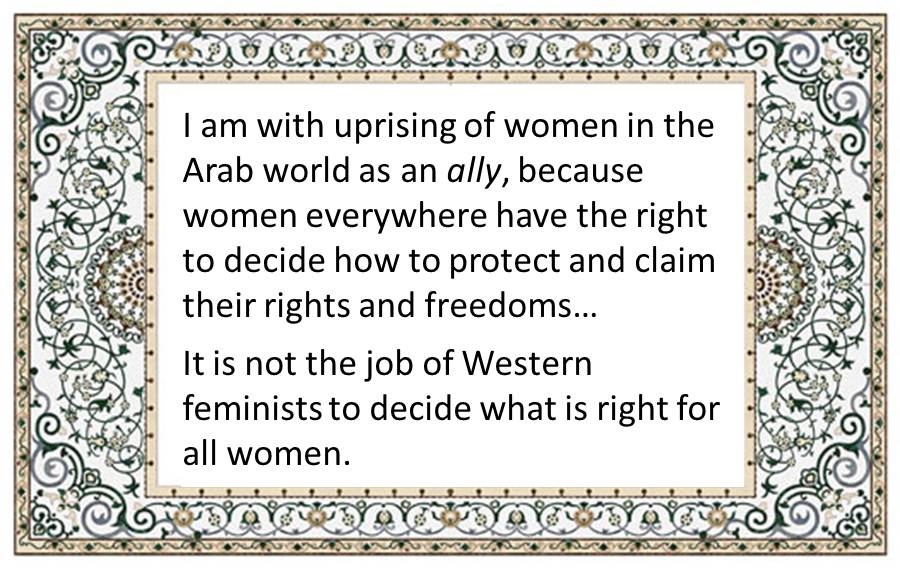
The intifada, or uprising, of women in the Arab world is a campaign that truly excites me. I “made friends” with the group on Facebook via the Femina Invicta FB page a while ago, but truly became enamored of them when they kicked off their photo campaign, “I’m with the uprising of women in the Arab world because…”, which has gone viral, and includes statements from women and men from Arab countries, as well as from supporters around the world.

Femina Invicta was invited to add to the campaign, but ultimately my picture was not included, I guess because the sensitivity of my posting from occupied Palestine, a decision I completely understand and respect. My support remains unwavering.

This is what it said:

See the Facebook page here http://www.facebook.com/intifadat.almar2a

Scroll down for selected images…

And the following is an article on the page and campaign’s success via Facebook campaign for women’s rights goes global – Daily News Egypt.

****************************************************************

A women’s rights group has launched a social media campaign to promote women’s rights across the Arab world.

The Uprising of Women in the Arab World group launched the campaign on 1 October, encouraging Facebook and Twitter users (female and male) to upload photographs of themselves holding a sign reading “I am with the uprising of women in the Arab world because…” followed by their reason to support the cause. Since the launch of the campaign, to mark the anniversary of the launch of the group, there have been over 200 replies with more being posted each day.

The group was started in October 2011 by four female activists, Yalda Younes, Diala Haidar from Lebanon, Farah Barqawi from Palestine and Sally Zohney from Egypt. They started the group to harness the social and political progress of the Arab spring. They believe that the calls that came from across the Arab world for freedom, justice and dignity cannot be fully achieved without the inclusion of women.

The group’s slogan is, “together for free, independent and fearless women in the Arab world.” Currently the main source of contact for the group is through their Facebook page and Twitter account. They receive posts from all over the Arab world, however support has also come from as far afield as Spain, Sweden, America, Brazil and Italy.

The group has many demands including, “absolute” freedom of thought, the right to autonomy, equality with men, the abolishment of all laws violating the Universal Declaration of Human rights and protection against domestic violence.

The campaign aims to “highlight the various kinds of discrimination against women in the Arab world” and to “re-open the debate in the social media on women’s conditions.” The group hopes to create a base for feminist activism and to highlight that despite the relative success of the Arab spring in many countries, the issues facing women are still present in society.

Responses have come from both women and men, all giving different reasons for why they support the campaign. Ragheed from Syria said, “I am with the uprising of women in the Arab world because my mother, my sister, my girlfriend, my daughter are independent human beings, they are not my followers.” Assil from Palestine said, “I am with the uprising of women in the Arab world because it’s not fair that I have to be trapped at home [for] three months to prove to people that the baby in my womb is my late husband’s.”

The group’s Facebook page raises a number of issues affecting both men and women in the Arab world, including the issue of homosexuality. Mohammad from Oman posted his picture with the sign, “I am with the uprising of women in the Arab world because all the religious, social, and sexual oppression I was subject to was directed towards the female inside of me.”

****************************************************************

Ahlam from Palestine

I am with the uprising of women in the Arab world because it’s the woman’s right
to stay single as long as she wants and not be labeled as defective.
And because it is my right to choose the type of education and career I want
irrespective of my future role as a wife or a mother

 ~*~

Sara from Yemen

I am with the uprising of women in the Arab world because
it is allowed by law to rape me when I am a child
in the name of marriage.

 ~*~


Walaa from Syria

I am with the uprising of women in the Arab world because
my mother should have chosen whom to marry
instead of whom I should marry

 ~*~

Abdulkareem from Saudi Arabia

I am with the uprising of women in the Arab world because
I am 16 years old and according to the law,
I am the guardian of my widowed mother.

Revolt mother!
You are strong, you are free!

Activists Brand Themselves in Solidarity with Farm Animals

On October 2nd 2012, world farm animals day, three animal rights activists in Israel got branded with a hot steel brand, in the same way farm animals are branded in factory farms.

Trigger warning for animal cruelty on the first vid.

***

See also

http://www.facebook.com/269calf

The Kissing Sailor, or “The Selective Blindness of Rape Culture”

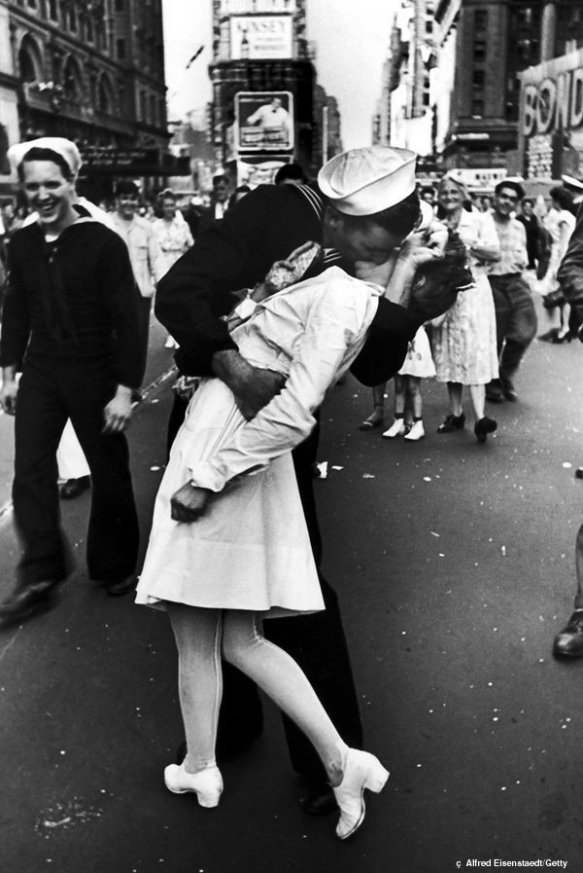
Most of us are familiar with this picture. Captured in Times Square on V-J Day, 1945, it has become one of the most iconic photographs of American history, symbolizing the jubilation and exuberance felt throughout the country at the end of World War II.

For a long time, the identity of the pair remained a mystery. It certainly looks passionate and romantic enough, with many speculating that they were a couple – a sailor and a nurse, celebrating and sharing their joy. This year, however, historians have finally confirmed that the woman is Greta Zimmer Friedman, a dental nurse at the time, and George Mendonsa, a sailor.

Have a look at some articles about it. Do you get the feeling that something is not quite right?

Huffington Post

Daily Mail

CBS News

A few facts have come to light. Far from being a kiss between a loving couple, we learn that George and Greta were perfect strangers. We learn that George was drunk, and that Greta had no idea of his presence, until she was in his arms, with his lips on hers.

The articles even give us Greta’s own words:

“It wasn’t my choice to be kissed. The guy just came over and grabbed!”

“I did not see him approaching, and before I knew it, I was in this vice grip.”

“You don’t forget this guy grabbing you.”

“That man was very strong. I wasn’t kissing him. He was kissing me.”

It seems pretty clear, then, that what George had committed was sexual assault. Yet, in an amazing feat of willful blindness, none of the articles comment on this, even as they reproduce Greta’s words for us. Without a single acknowledgement of the problematic nature of the photo that her comments reveal, they continue to talk about the picture in a whimsical, reverent manner, “still mesmerized by his timeless kiss.” George’s actions are romanticized and glorified; it is almost as if Greta had never spoken.

In a way, I understand this. The end of war is a big deal, and the euphoria felt throughout the nation on that day is an important part of American history. For so long, this photograph has come to represent that unbridled elation, capturing the hearts of war veterans and their families alike. The fact that this much-loved photo is a depiction of sexual assault, rather than passion, is an uncomfortable truth, and to call it out as such might make one seem to be a priggish wet blanket. After all, this sailor has risked his life for his country. Surely his relief and excitement at the end of the war is justified? Surely these are unique circumstances? The answer to the first question is yes. He is perfectly entitled to be ecstatic. He is perfectly entitled to celebrate. However, this entitlement does not extend to his impinging on someone else’s bodily autonomy.

The unwillingness to recognize a problem here is not surprising, considering the rape culture in which we live. It is not easy to assert that a woman’s body is always her own, not to be used at the whim of any man without her consent. It is far easier to turn a blind eye to the feelings of women, to claim that they should empathise with the man, that they should be good sports and just go along with it. And the stronger the power structures behind the man, the more difficult it becomes to act otherwise. But if we are serious about bringing down rape culture and reducing the widespread violence against women, then we need to make it clear that engaging with someone sexually without consent is not ok, even when it is an uncomfortable position to take. Especially when it is an uncomfortable position to take.

via The Kissing Sailor, or “The Selective Blindness of Rape Culture” | Crates and Ribbons.

Just How Easy It Is To Give In To Institutionalized Racism

A personal anecdote, which just happened about half an hour ago.

(I think sometimes the small, everyday indicators of how wrong things are hit home more powerfully than the worst horrors we see in pictures or on the news, which are often too gruesome to truly grasp.)

*****************************************************************************************

I sent a shipment to London for a trade show. Brochures, pens.

I get a message that my shipment is held up at security, with a phone number to call. I call.

The security officer asks me a series of expected questions: What is in the boxes, who packed them, were the items special order or from stock in your office, who else knows where the shipment is going… I answer.

Then she asks: Do you have any Arabs employed at your company?

I answer, no.
My stomach is knotted, because I am very unhappy that the level of discrimination against Arabs means that it is pretty obvious that we would have no Arab employees. But I am also relieved, on some level, because I need my shipment to go out, my job depends on successfully getting my projects off the ground.

She asks, do you employ any foreign workers? No.
Not even as cleaners? No.

Okay, your shipment is cleared.

Congratulations to me. I am certified to send brochures to London, all at the tiny price of apartheid.

I feel sick to my stomach.

*****************************************************************************************

Thirty Years of Poverty

Click the link or image to see the interactive map

http://www.usatoday.com/news/graphics/2012/poverty-maps/index2.htm

Each map shows counties where the poverty rate is 20% or higher for kids or the elderly or for both. Use the slider to see how those patterns have shifted from 1980 to 2010.

Sources: Census Bureau data; Kenneth Johnson, University of New Hampshire, analysis by Paul Overberg, USA TODAY

By Jerry Mosemak and Chad Palmer, USA TODAY


The Lady Manes

A self-portrait series by Rhiannon Schneiderman

From Rhiannon Schneiderman's photography blog:

The Lady Manes is a series of eight self-portraits. In each image I’m standing in your typical feminine pose in an outfit or article of clothing, and I’ve accessorized each outfit with its own unique, stylized ‘Lady Mane.’ A ‘Lady Mane’ is just a somewhat empowering pseudonym for a bunch of pubes, a “bush,” your “hair down there”… And that’s what the series was about for me: empowerment. I can’t really pinpoint any one source of inspiration for the project because it really was a culmination of so many things going on at the time; I’d moved to and lived in Daytona Beach, the armpit of Florida and possibly all of civilization, for almost two years (for school) during which time I’d witnessed and been subject to some pretty amazingly sexist ordeals. I was moving more into my hardcore feminist phase, which I think every lesbian in their 20’s goes through, and just so happened to have a hardcore feminist, fine-arts-major professor who had been giving me a semester of the most intense and life-altering class critiques I’d ever experienced. I’d been introduced to Cass Bird’s “Rewilding”, an amazing body of work that continues to influence me. All of these things, and maybe a few Lady Gaga songs, were inspiration enough to create a series that kind of laughed at conventional gender norms. I wanted to tell people that they were ridiculous, makethem uncomfortable for a change. I wanted to challenge femininity and the objectification of women that is still so incredibly prevalent in society. I guess it was my way of saying, “Fuck you. Enough is enough.”

read more