Thursday Round-Up

Personal and work pressures make it difficult to be as focused as I’d like on my pet topics. But these great blogs and articles keep coming my way, so I thought I’d share some. If it works out I’ll do it regularly.

Gender Violence

Dear Abby, Thank You for Saving My Life

December 6 was Canada’s National Day of Remembrance and Action on Violence Against Women, held each year on the anniversary of the 1989 École Polytechnique Massacre, where 14 young women were killed for being women.

In this moving post, Marvelist shares her own story and her thoughts on Canada’s decreasing support for gender equality.

16 Days of Activism Against Gender Violence

The 16 Days of Activism Against Gender Violence is an annual international campaign that runs from November 25, International Day Against Violence Against Women, to December 10, International Human Rights Day. Over 2000 organizations in 154 countries have participated in the campaign.

I wanted to post this before the 16 days were over… Oh well. It’s worth noting anyway.

  • Nobel Women’s Round-UpIf you click on nothing else, DO check out the Nobel Women’s Initiative 16 Days of Activism blog: Each day features another amazing woman activist from a different part of the world: Palestine and Israel and the Congo and Iran and South America… Well, there are a lot of amazing women out there!!

  • And here is a great initiative that runs during the 16 days, aimed at encouraging girls and women to take control of technology and end violence.
    Take Back The Tech
From The Queer Activist Blogosphere

The Social Justice League’s blog post Fauxgress Watch: “Born This Way” examines why it is actually detrimental to queer folk to use the argument “we were born this way” or “being queer is not a choice!” as a justification for seeking rights/equality.

Nobel Peace Prize Winners

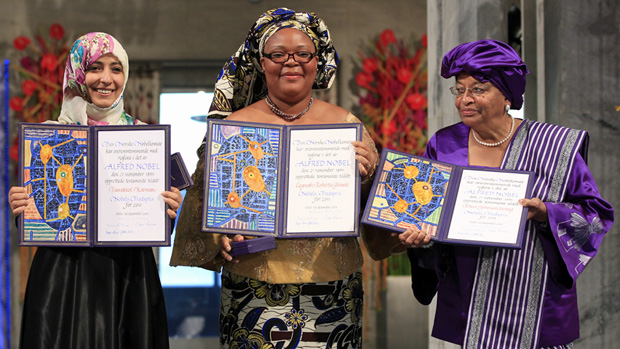
Of course, I had several tearful moments watching three women accept the Nobel Peace Prize. Women from areas fraught with violence, who were brave enough to find their personal power, raise their voices, become leaders, and make a change.

Heifer International – an organization committed to ending hunger and poverty – opine that these three women can start a movement.

Culture & Media

Deconstructing the Bechdel test

Ana Mardoll discusses what the Bechdel test is actually for.

Rethinking the Strong Female Character

Feminist literary blog Canonball’s thought-provoking post on why we might want to rethink what Hollywood considers to be strong female characters.

The weekly Trope

I will love and/or curse my lovely friend L. forever for getting me hooked on TV Tropes. Today’s trope: Abuse Is Okay When It Is Female On Male

And of course, the “shocking” discovery that rapists and men’s magazines sound suspiciously alike

An investment manager’s email asking for a second date 

This email had me laughing out loud in my office. There are a LOT of responses, but so many of them are just so hysterical it’s worth scrolling around a while.

In Israel

Israeli former president, Moshe Katsav, finally begins his prison sentence for rape!

This New Yorker blog post gives a quick history of the case.

How our fearless leaders REALLY see women (without their uniforms!!)

But sexism is still rife at the top of Israel’s government and military, as evidenced by the “joke” – caught on tape – in which Defense Minister Ehud Barak and army Chief of Staff Benny Ganz objectify female soldiers and one of the minister’s own media team. These two senior men then threaten the press if they release the tape.

Murder of Mustafa Tamimi

I began this as an item in my roundup, and it grew, and grew… So this horrible episode got its own post.

The Murder of Mustafa Tamimi

This is not the type of thing I normally write about. Not because it isn’t important, but because some issues are too big, complex, emotional, incendiary, and controversial for me to get a handle on. But this week I was swept up in this tragedy, so I want to include it here.

This was originally part of the round-up post I’ll be publishing shortly. But it got so big, and it is important enough to merit it’s own post. So in some ways it covers all the links to the event, reactions, lack of reaction, photos, video… And in other ways I still don’t feel it’s a complete post. I would normally give some background on the conflict, on Nabi Saleh, on the laws governing protests in the West Bank (or in other words — why Palestinians don’t get even the basic right to assemble)… I might share my own feelings about this, bring other examples of similar incidents, some statistics… But this is what I can do right now (and this is why I generally don’t do this kind of post!)

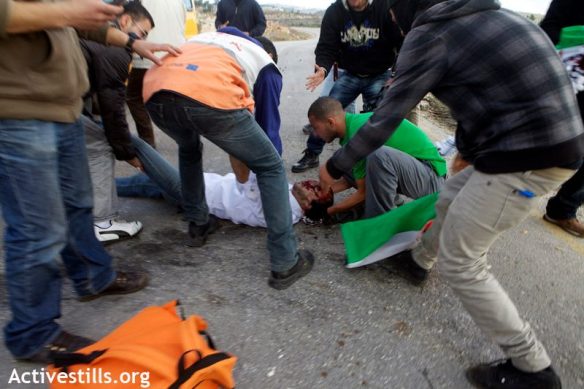
The short version: Mustafa Tamimi was a Palestinian who on December 9, 2011, participated in a protest (which takes place every week) in Nabi Saleh, a village near Ramallah (read more about the struggle in Nabi Saleh here). He was shot by an Israeli soldier, in the face, at close range, by a tear gas grenade (crowd control weapon designed for launching into the air; all prescriptive uses of this grenade launcher call for this use only, including the IDF’s own regulations). He died from his wounds.

Articles telling the story:

Here is a news article covering the story: Nabi Saleh Palestinian Shot In Head With Tear Gas Canister (warning: includes graphic photos)

Here is a chilling first person account of the event by Palestinian activist Linah Alsaafin.

And another by Ibrahim Bornat.

Videos:

Here is a video of the protest:

Here is a video that includes a photo sequence of the shooting

(warning: graphic photos)

Photo Album

Here is a Facebook photo album of the entire Nabi Saleh protest, including photos of Mustafa Tamimi being shot (warning: graphic photos)

.Here is the Israeli government’s response

Palestinian Protester Death an Exceptional Incident, Say IDF Officials

Here is a video proving it is NOT an exceptional incident, but rather a policy, “informal” as it may be:

.

And to add insult and injury on top of injury and insult, the Israeli military attacks mourners at Tamimi’s funeral

Human Rights for Palestinians?

The irony of Tamimi’s killing occurring on Human Right’s Day is not lost upon many of us.

Memorial For Palestinian Human Rights

Equal Rights for Renting Women’s Bodies?

Another hot topic causing me distress these days: The fight for equality for gay men under Israel’s surrogacy laws. Grrrrr, talk about a can of worms. I’ve already butted heads with people I usually like and agree with on this. Here’s why.

Most people I know – of liberal leanings – have this kneejerk reaction: Yes! Equality for gays! Enhanced rights and opportunity for parenthood for gay couples! Yay!

Have you figured out what’s missing in this scenario? Yes, indeed – the same person who is being stashed out of site on an increasingly frequent basis: The woman.

Who is providing these surrogacy services? Who is looking out for her interests? Is there even any discussion about it? Any medical, legal, ethical, financial, or psychological standards being adhered to? Or being crafted, if there aren’t any in place?
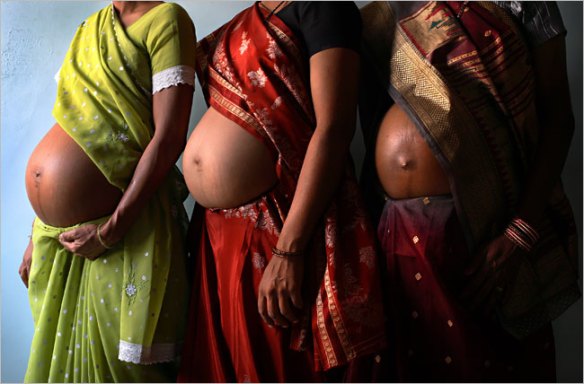
Surrogate Mothers, India

How many people know what is involved from a health perspective (physical and mental) for the woman providing her body as a service? Versus how many people are jumping in with both feet with accusations of “Homophobia!!” at even the hint that such a discussion should take place?

(And let’s be very clear: no one in the discussion I’m referring to is advocating that heterosexuals should be allowed to this, while homosexuals should not.)

Why is it so easy to ignore the woman?

Here’s some background:

Israel was the first country in the world to legalize surrogacy, in 1996. While some (liberal?) feminists celebrated this as a victory for a woman’s legal freedoms (for example, to enter contracts, and autonomy to determine what to do with her body), other (radical?) feminists immediately classified the practice in the context of a patriarchal society’s attempt to use women’s bodies to further patriarchal ends.

But maybe some more background about Israel and the issue of procreation is needed here.

Israel is unique in its pro-natal attitudes, especially compared to other Western countries, in the sense that having children (Jewish children) is considered an imperative. Not only a cultural imperative, not simply a religious imperative, it is also a political imperative. This is for several reasons:

In the aftermath of the holocaust, many believed that Jews must reproduce to replace the 6 million lost. Others, including the political leadership of the time, viewed child-bearing as a military imperative – women must produce soldiers for the army (first Israeli prime minister Ben-Gurion famously wrote that “Any Jewish woman who, as far as it depends on her, does not bring into the world at least four healthy children is shirking her duty to the nation, like a soldier who evades military service.”). Part of it is traditional – Judaism is family-centric. Part is purely religious – the ultra-orthodox in Israel have a birth rate that is twice that of Muslims, and four times that of secular Jews.

Over the past few decades, one of the most common themes has been the “demographic threat” – if Israel wants to maintain both its identity as a Jewish state and remain a democracy, it simply must maintain a Jewish majority in relation to the Arab population. (Or, for more right-wing sectors, simply “winning out” vs. the Palestinians is the point, without regard to the democratic nature of the country.)

Whatever the reasons, the imperative is deeply ingrained in the culture, which places pressure and socializes people to place child-bearing at the top of their life priorities. It also created a legal and medical system in which parenthood is encouraged and state-supported through:

  • Reproductive technologies. Israel is the leading country in the world in in-vitro fertilization, leads in development of reproductive technologies, and also provides financial support for the procedures.
    (I can (and maybe will) write entirely separate posts about the negative effects this has on women, and how many of the procedures are untested, how low a concern safety is, on the cultural impact on women of being state-sponsored wombs… But alas this post is on another topic which I shall promptly get back to.)
  • Support of single-parenthood, through various methods including sperm banks (artificial insemination, IVF), adoption (international) and of course —
  • Surrogacy.

Okay. So now you might be getting an inkling of what parenthood means to Israelis.

And of course, the fight for equality and recognition of LGBT people’s rights to become parents, and creating legal and societal mechanisms for parenthood to be a realistic possibility, is an important one.

So, what’s actually going on?

As I said, Israel legalized surrogacy in 1996, and was the first country to do so. There have been various judicial decisions along the way determining who can do it, where, how… The bottom line is that under the current rules, only heterosexual couples can hire a surrogate to carry a child for them. This can occur either in Israel or abroad. Homosexual couples or single people cannot (as far as I understand it) contract a surrogate in Israel.

Gay couples can hire a surrogate in the US or India, but a court decision last year regarding DNA tests for both fathers has created some hindrance even to this practice.

So recently, a campaign began to change the law – though a Facebook page (in Hebrew) and an Internet petition. This has brought the discussion back to the forefront in both LGBT and feminist circles, as well as to the broader media and legal communities.

Another Facebook page – Gays Against Surrogacy (in Hebrew) – soon followed. As I mentioned before, claims of homophobia quickly surfaced.

And hence my personal frustration:

First of all, the LGBT association – or Aguda – Israel’s main LGBT advocacy group, is strongly supporting this initiative, to the extent of overshadowing just about any other issue. So once again, the interests of a minority of men, who are primarily white, homonormative, and from a socioeconomically advantaged background are taking precedence over, say – teen prostitution in the LGBT community (which is on the rise), teen suicide, transgender rights, AIDS awareness, or a myriad of other LGBT issues. I’m pretty sick of this lack of wider representation. If it’s the white gay men’s association, they should just say so.

And once again, women are being submitted – physically, mentally, financially, and legally – to the needs of men (or at least to the patriarchal priorities of this society).

I want to support parenthood rights for gays. I *do* support all brands of equality. I cannot, by any stretch, get behind yet another initiative that subordinates women to anyone else’s agenda.

~*~

Here are some resources on the topic for anyone who wants to read more:

From Isha L’Isha Feminist Center:


Old Patterns, New Ideas 
By Hedva Eyal
Council for Responsible Genetics

“There is plenty of scientific knowledge and understanding of health risks as a result of hormone treatments associated with in vitro fertilization (IVF). This raises questions about the widespread use of this procedure, especially when women are exposed to these health risks not for themselves but to conform to other people’s desires. Establishing surrogacy as a prevalent, accepted way of bringing children into the world entails significant risks to the surrogate mother herself, to the child, and to society”

Google Baby – a documentary on surrogate mothers in India:
Focused on a clinic in rural Anand where peasant women give birth to babies ordered over the Internet through an Israeli “pregnancy producer.” Western hetero and gay prospective parents click on the sperm and eggs of their choice, enter credit card details, and later travel to Anand to receive the newborn they couldn’t or wouldn’t conceive themselves.

Fertility policy in Israel: the politics of religion, gender, and nation, by Jacqueline Portugese

Surrogate Motherhood and the Politics of Reproduction, by Susan Markens

Explores how discourses about gender, family, race, genetics, rights, and choice have shaped US policies aimed at this issue.

Article: Homosexual Couples Fight for Right to Surrogate Pregnancy
(Note the complete lack of any reference to the legitimacy or risks of the practice)

Will Israeli Court Decision on Surrogacy Bring Changes for Gay Couples? Blog post, The Sisterhood
“In principle, I agree completely with the Court’s decision in favor of the petitioner who wants a fourth child. But there is also the reality of scarce resources to consider. I would have no issue with the Court’s decision if surrogacy were not a highly limited and regulated commodity in Israel.”
A commodity, indeed.

Israeli Feminists Slate Surrogacy, BioEdge, bioethics news

University of Technology, Sydney Law Review: Surrogacy in Israel: A Model of Comprehensive Regulation of New Technologies – [2005]
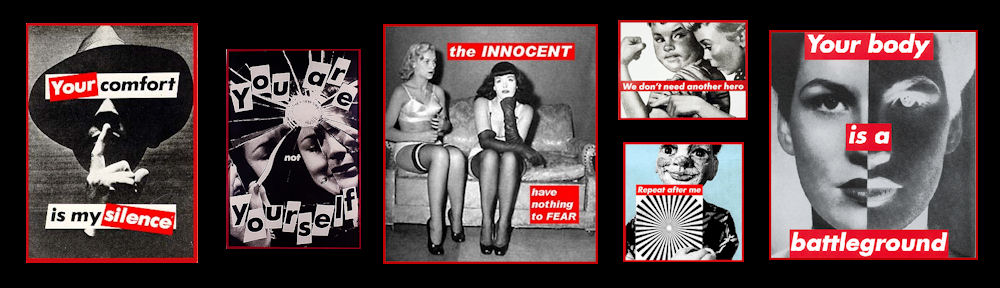

Anti-Woman Israel

I haven’t written as much as I planned in the past two weeks. I had a (too-long) list of topics to cover: Princess Culture, Why/how women are not taught to say NO, “Sitting at the table”, teaching girls to be smart rather than pretty, and more.

But while my sort of intro-level feminist posts were boiling in my head, things were happening around me that I just couldn’t deal with, and which affected my ability to focus on my planned posts. I live in Tel Aviv, Israel. I’m not sure how much coverage there is internationally about what’s been going on here… The international press is famously inaccurate and biased (in all sorts of directions) in covering this region. So I’ll give a snapshot.

The (very) short version is that there are two related and very frightening trends happening here:

The first is a growing wave of nationalism, which includes increasing violence towards minorities, a surge of anti-democratic legislation designed to silence protest and opposition, curtail the activities of human rights groups, promote settlement in West Bank territories, giving enhanced rights to orthodox Jewish minorities at the expense of, well, everyone else…

The second is an increasing exclusionary and discriminatory attitude towards women. This has manifested in several ways, including government support for segregated buses and public transportation in Jerusalem, the removal of women from public images (such as billboards and posters) in response to orthodox pressure, separate sidewalks for men and women (as a matter of fact – even when the supreme court ordered this to be stopped, the municipality refused, and when the one woman on the city council protested this, she was fired)… Male soldiers walked out of a military ceremony because women were singing, behavior they were not punished for, and as a matter of fact they seem to be getting the support of the powers-that-be, meaning that women will be further silenced and segregated in the army. (One leading rabbi says soldiers should “choose death” rather than listen to women sing). Women are being excluded from judiciary committees, and several leading female news professionals are being fired from their jobs – based on age and appearance (keep in mind the female presence in Israeli news is minimal to begin with). Teachers’ faces are blotted out of educational campaigns. And more.

An ad in its original form (right), and cropped for publication in Jerusalem

(Well, there are also economic trends, with the government passing laws that put more money into the pockets of cartels/tycoons, and take more away from the rest of us. And more stuff. But how much can I possibly focus on? Or deal with, without just keeling over??)

I haven’t been covering any of this in my blog, keeping my activism to my local community and Facebook. Because I didn’t feel I could do the topic(s) justice in the amount of time I have to write. But the fact that I got as overwhelmed as I did made me realize that if I didn’t write something about it, I would never get back to my personal blog agenda – which also includes queer/LGBT topics, which are falling ever-further behind.

So for now, I’d like to share some of the actions that have come (primarily from women) in response to some of these anti-woman trends. (read more here)

1. Poster campaign:

Following the literal erasure of women from public advertising (including, by the way, from the entire campaign for organ donation), several women conceived a campaign consisting of a photo shoot of women, and printing posters that people could hang from their windows or balconies, creating a female presence in Jerusalem in spite of the religious pressure for erasure.

The campaign’s taglines were: Not Censored and Bringing Women Back to the Public Spaces

2. Photo Shoot

50 young women pose for nude photo in identification with, and support of, Egyptian blogger Aliaa El Mahdy

"Love Without Boundaries"

3. Women Sing!

A public singing event was coordinated in four different cities (including Jerusalem) where women declared in the most direct manner possible: We will not be silenced!

The Jewish proscription against women singing is based on the idea of “Kol B’Isha Erva” or, “the voice of a woman is nakedness”, where the word for nakedness actually means literally  “the pubic region”, and is used for “lewdness”. Therefore, immodest/impure/prohibited. The protest event was promoted as “This is not what “pubic” looks like”, and subtitled “Don’t Stop Singing!”.

(I looked but couldn’t find myself in any of the photos…)

4. Women journalist campaigns

(mostly In protest of the firing of Keren Neubach):

  • “Mute Protest” today, in Tel Aviv and Jerusalem (FB event is in Hebrew. Here is the Occupy Israel protest post. ) (The idea being, of course, that women’s voices are being silenced. Neubach is one of a very few women in journalism who actually has a POV)
  • Petitions: There are several. Here’s one (in Hebrew).
  • Return Women to the Screen campaign (on the Paucity of Women in Israeli News): http://blogs.forward.com/sisterhood-blog/146101/

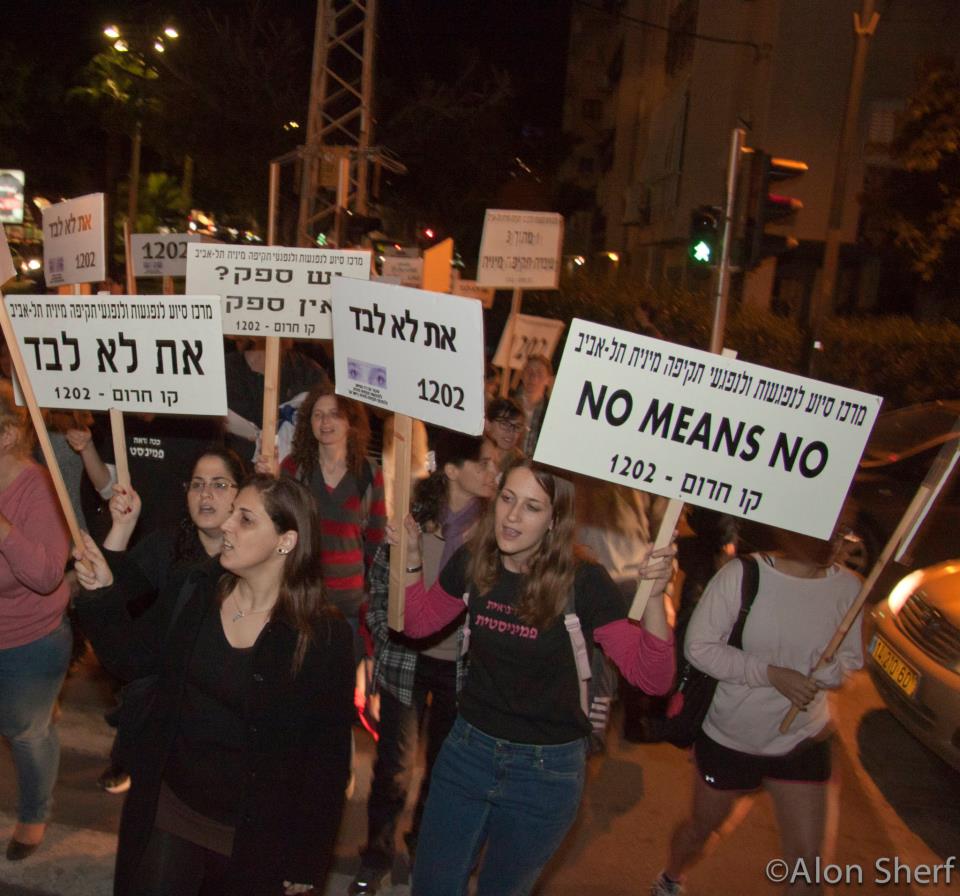
5. March and Rally for the International Day for the Elimination of Violence against Women

See photos here

How Many Slaves Work for YOU?

Seems like a worthy topic to kick this off.

Didn’t know you have slaves working for you?
Even in the so-called “free world”, a great many of the products we use are touched by slave or otherwise exploited labor at some point in the manufacture or supply chain.

Go to this site and take the survey to learn more about modern slavery, and to discover what your slave footprint is.

Slavery FootprintWhile the survey and results are likely depressing to read, there is a bit of good news. The Slavery Footprint organization gives you a range of tools to let companies know you want them to account for where and how they obtain their materials.

And of course, they make it easy to spread the word and compare your results to other people’s.

*****************************************************************************

My score was 28. This is a bit above the general average, but below the average for my age/sex/location.