Femina Invicta

Feminist. Activist. Blogger.

Femina Invicta

A Personal Account by an Israeli in the Middle of the Genocide

A tiny bit of background: This is a text written by A, an Israeli who is also an intersectional activist, including being anti-Zionist and in solidarity with Palestinian liberation. A is friends with P, a Palestinian man who lives in the US. P’s home was destroyed as part of the ethnic cleansing that was done by Yitzhak Rabin in 1967. P, who is doing a lot of public speaking and activistm these days, asked A for some comments on the ongoing situation as “someone in the middle of things”, to use in his talks. A says that they felt frozen during the first weeks of the attacks on Gaza, and this was the first time some words came, that they aren’t necessarily a coherent account of anything, and of course, they are subjective and personal. And unedited except for the names. They were written after the first stages of the attack, but before the complete annihilation of northern Gaza. A asks that this text not be taken as a victim statement in any way, as it’s clear who the true victims are. But because the text was asked for, and an Israeli anti-Zionist view is rare, there is some small space being made for it here.
Genocide in Gaza: Not in my name

My dear friend P

You’ve asked me to share a paragraph or so of my thoughts, and I so want to help, but that seems like such a sound bite, and I’m not a good politician… So I thought I’d write some random thoughts and then I’ll either take something from here, or give it all to you and you can take whatever you want from it. 

First, I’d like to address how unable I’ve been to express myself since October 7. Part of it is sheer horror. I don’t even know what to say that is proportionate. Or that feels effective. And feeling wordless isn’t a usual feeling for me. Part of it is being anti-Zionist in an Israel awash with bloodlust. It’s always othering to be of my political leanings here, and some activists (I don’t think I’m among them but who knows?) have been on the Security Forces radar for years already… But now it’s much more immediate: The threat to one’s livelihood, the threat to one’s freedom… Even for privileged white Israelis, and of course, much more so for Palestinian citizens. I’ve never been ruled by fear, I don’t think that completely explains what I’m feeling now. It’s more the sense that I don’t have any peers now. I’m sure it’s not 100% true, but it’s true enough. 

In my Hebrew language/Israeli social media, I don’t have bloodlust (because I curate), but I do have general pro-Israel, pro-army sentiment, or from the usually vocal leftists, only focus on the hostages. A lot of anti-government rhetoric, but only of this *particular* government, not the legitimacy of the whole project it’s a part of. Very few people are speaking out, though that’s slowly changing as the genocidal slaughter continues. 

In my non-Israeli social media, there is plenty of pro-Palestine and anti-Zionist sentiment, but so much of it is peppered with antisemitism (no, I don’t mean the slogan “from the river to the sea”), and even more is just… Ignorant. It’s really hard to get behind people pontificating pure nonsense about the history of Israel, Zionism, Palestine, this or some other war, this or some other movement… I despair. 

So I’m having trouble finding a political home, and I’m having trouble being the voice that is a clarion call for an informed, humane, justice-oriented discourse. 

Of course it isn’t as if those voices don’t exist, they are just hard to find amid all the others. And people being people, someone good on Palestine is then found out to be transphobic, or someone good on trans issues is found to be Islamophobic and so on forever. 

The next thing that comes to mind is my subjective experience of this time. My political beliefs remain unshaken (which isn’t true of everyone in my local sphere), but at the time that I had literally hundreds of missiles exploding over my head, it was hard to put my emotions and politics in order, especially in a way that could be clearly expressed. Even if I had felt I had a good place to share. Because I live in Israel, and my friends and cohorts are here, I can’t NOT be affected by my friend who is terrified for her children each time a missile warning siren blares, or the other friend whose cousin was taken hostage, or the other friend whose nephew was murdered at the music festival. None of which made me less caring about the Gazan lives lost. But another thing I’ve learned during this time is that all of us, no matter who we are, feel more strongly, more immediately, about someone whose name we know, whose picture we see, and during those early days, I didn’t know the Gazan names, I could only watch in horror as the body count grew. 

And then, of course, as Israel’s murderous response continued to take more and more Palestinian lives, and the religious zealot settlers in the West Bank escalated their pogroms (and that is hardly even considered newsworthy in comparison) my despair and pain grew even more unbearable, and all the while, I continue to live a relatively calm life, but one in which I need to go into work every day, and work alongside people serving this army, this political agenda, supporting this government… People who at best think it’s an awful situation but not entirely uncalled for, and at worst are perpetuating it themselves. 

When I open the app to order a taxi, each car has a little Israeli flag on it. The popup message on the grocery website calls for support of “our soldiers”. All the billboards have nationalistic messages and flags, all the high-rise towers are lit up with proclamations of how “together we will be victorious”. I’ve adopted the habit of putting in ear buds any time I’m out in public, because I can’t listen to the radio, or hear the casual conversations taking place everywhere.

I can’t handle seeing yet another dog or cat abandoned by their relocated families, or who are simply lost, wounded, starving, and need help. For a while, it seemed like everyone I knew was going from one funeral to the next, and it felt never ending. During this time, I managed to avoid seeing the worst of the images from Gaza, which I didn’t think I could handle, but now, as the unimaginable is proving itself all too real, that is no longer true, and I can’t really handle those images either. 

And then there’s the guilt, the guilt that I don’t feel I can help, the guilt that it’s being done in my name, the guilt that I still have my comfortable life while others’ are lost. In more than the literal sense of dying, as the terrors affect the survivors (and who knows if they will remain survivors) who are wounded, who have lost limbs, who have lost homes, who have lost their families, who are starving, who are uprooted, who are in constant danger… With the clear knowledge that this trauma will transcend generations.

When I can get out of my feelings, here are the next things I think about. 

I think about the Holocaust. As someone who grew up in its shadow in a community of survivors, whose grandparents became refugees, and whose education (as an Israeli and very much as a Zionist) was centered on this event, some of the most persistent questions I’ve heard over decades and decades are “how could all those Germans remain silent?” with the corollary, that if they didn’t do anything against it, they were accountable for it; and “What would you do if you were there?” To which, of course, we all want to answer that we would have been a Mordechai Anielewicz (leader of the Warsaw Ghetto rebellion) or a Sophie Scholl (of the anti-Nazi White Rose movement)… 

But in truth, most of us are just living our lives, even if we feel pain or shame or despair or any other emotion. Hannah Arendt spoke of the banality of evil, and she was talking about Adolph Eichmann. It is even more banal to just be a person who lives in a place in which truly terrible things are happening. 

Of course, many people on the internet are acting as if the terrible things just started, but I realized a few things about the ignorance of even the most well-meaning amongst them, when it comes to Israel. 

For example, I don’t think people realize how deep and how complete the brainwashing is here. If all your life, including geography and history lessons in school, you’re shown a map of your country that looks like it extends from the Jordan river to the Mediterranean, you think that’s your country. I was never told there was a Green Line, I discovered that after moving to the US. If your history lessons tell you that you are a consistent victim of aggression from the many countries surrounding you, you grow up to be an adult who believes their life is in constant danger. If it’s actively hidden from you that Arab villages used to exist where your town or village now stands, or if it’s existence is known, but you’re told that the Arabs ran away so that the Arab armies could defeat the Jews and then they would come back to finish us off – you grow up without a doubt that this is real, because this is how ALL of us learn reality. 

You’re never taught that the UN vote on the division of Palestine was a non-binding one, that the UN doesn’t have that kind of power, nor that the Palestinians weren’t under any obligation to agree to it. The only thing you’re told is “it was voted on” and “the Arabs rejected it” and therefore anything that happened since is their own fault. The list goes on. 

The systematic erasure of history, of name places, of actual people, who were displaced, set the groundwork for everything we’re seeing now. Many people on social media wring their hands demanding to know “how can this even be happening in 2023???” and well, this is one reason. 

The other, of course, is that terrible things happen all over the world all the time, and if you haven’t been aware of it, that simply speaks to your privilege. Human history is littered with genocides, and in between other forms of massive human rights catastrophes. I’m not whatabouting this, I want the focus on Palestine and Israel to continue. But like every form of activism, if you aren’t focusing on the systemic causes you aren’t going to fix the problem. 

If you’re from the US or Canada or Australia or Germany (et cetera), your country is part of the problem. Capitalism, imperialism, colonialism, white supremacy, destruction of the environment, and war! are all related. Like, if you enjoy the Olympics and haven’t really cared how many people are murdered, unhomed, and otherwise harmed to make it happen, I hope your caring about Palestine/Gaza is your wakeup call to a broader understanding of oppression. So please keep talking about Gaza, but also don’t think that the anti-trans politician in your own back yard wouldn’t do the same thing. He’s the same as the people ordering the destruction of Gaza. 

And if you’re feeling superior to Israel right now, you are wrong. Israelis are just people, like any other people. They run the gamut from kind to murderous, from left to right, from atheist to religious zealot, from smart to not, from funny to dull, from orderly to chaotic and everything else in between. People are capable of terrible things when the circumstances are created to enable them, and those of us concerned with justice need to be concerned with not allowing them to. And just because the worst horrors perpetuated by the US (etc.) aren’t necessarily happening where you can see them, it doesn’t mean they aren’t happening. Ask an Afghani person how they feel about it. 

Another thing I think a lot about is how racism, including antisemitism and Islamophobia, works. How it pits marginalized groups against each other, while the masters continue to benefit, raking in the money from arms deals, from political cachet, from deals with the devil. In the US people seem to be taking weird sides, like to prove one side is right they will say terrible things about Muslims, and the other side will deny there is any such thing as antisemitism anymore. Meanwhile, the main people perpetuating both are white Christians, who are also the holders of power, and they like it when we tear each other down. 

In Israel, Jews are the hegemonic group, so the formula is a bit different. But the anti-Arab sentiments here don’t only affect Palestinians (who are the most harmed, nevertheless). Systemic and pan-historic racism has also been aimed at the Jews from Arab and Muslim countries, against the Ethiopian Jews, against foreign workers from the Philippines, Thailand, India, Romania, Bulgaria and other places, against Sudani and Eritrean refugees, and more. A system built on racism will never adversely affect only one group, it will be rotten to the core. 

Too many people want to simplify the ongoing genocide as “evil”. And of course, it IS evil. Very evil. But what I mean is, we aren’t in a Disney film here. There is no inherently evil character vs. one who is inherently good. The question to ask is: Who benefits? And the answer is pretty easy. Those who want power (this includes Hamas). For the past 16 years, every time there was any threat to Netanyahu, any upcoming election, any kind of protest movement, he immediately created a “security threat” and started bombing Gaza. This time is no different, only more, bigger. Because October 7 was more, and bigger. 

Anyone not living in Israel probably can’t imagine what that day did, what it was. If the government hadn’t embarked immediately upon the military attack it did, it’s possible the government would’ve fallen. That’s how traumatized the population is. That’s how mad people are at Netanyahu, and this government, who as a whole and individually care nothing about anyone but themselves (or their core communities, for the religious settlers). There was no army there at the time, because it was moved to the West Bank to protect settlers. There is evidence that they knew of the Hamas plans, but ignored them. Because this situation keeps them in power. On an even more venal level, that isn’t talked about enough: Israel tests its weapons on Gaza, and then makes billions as one of the world’s leading arms dealers. If we didn’t have a reason to attack, how would these capitalist monsters (in direct league with the government) continue to prosper? 

I also think a lot about how little people know about Jews, and Judaism. Sometimes it’s an innocent ignorance (which doesn’t prevent them from declaring “facts” online), but I’ve encountered a new (for me) form of antisemitism during this period, in which people have very strong opinions about Jewish people not being a people, of there being no such thing as Jewish identity, only a religion. People confidently asserting that if I’m an atheist I’m not Jewish (I mean, even the most misogynistic, extremist, hateful, racist, jingoistic religious sects would see me as Jewish, who the F are these people even?), that there is no Jewish ethnicity or culture… And I haven’t yet figured out what agenda this serves, like I said: new. But it’s hateful. I experienced a fair amount of antisemitism when I lived in the US, and in encounters with Europeans, but they always either fit the age-old stereotypes (not that it was pleasant, just not surprising) or else part of a Christian-centered agenda (I’m clearly going to hell or something, and the US is a Christian nation in which I don’t belong, etc.).
(This isn’t my feelings about the situation per se, but the internet is just full of this stuff because of posts about the situation, and it’s become a central theme in my life these past weeks.)

P, I feel I’ve gone a bit off topic, or am just all over the place. If any of this is interesting, please give me a prompt (a word, phrase or sentence) and I’ll craft my response in a more focused way for you to use. Much love, A. 

Binder Madness

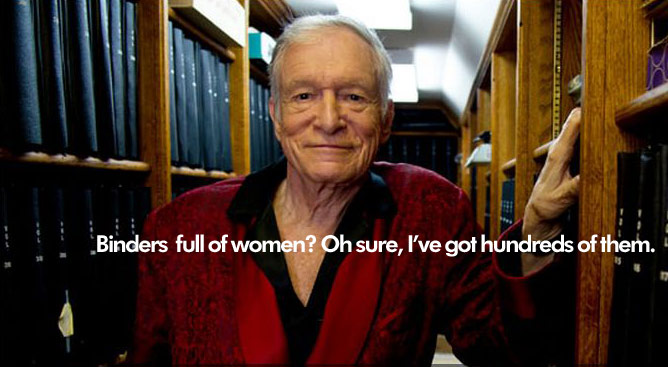
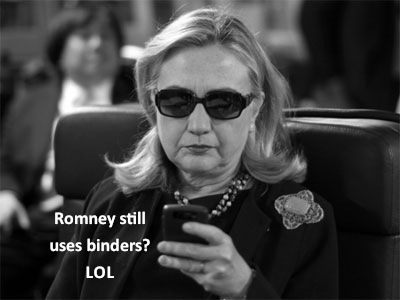
How fun to see the Internets go wild over the latest Romney gaffe, namely his “binders full of women” comment in the debate:

‘I went to a number of women’s groups and … they brought us whole binders full of women,’ former Gov. Romney said about his search to find more women candidates towork in his Massachusetts cabinet.The term went viral, spawning its own Twitter account and Facebook page

(Read more in The Daily Beast)

Of course, not only was the ostensibly positive claim offensive…Turns out it was also a lie.

.

So here is some of what's going on online:  

On Twitter, check out #BinderFullOfWomen and #RomneyGaffes hashtags

For more fun, check out the dedicated tumblr

Thirty Years of Poverty

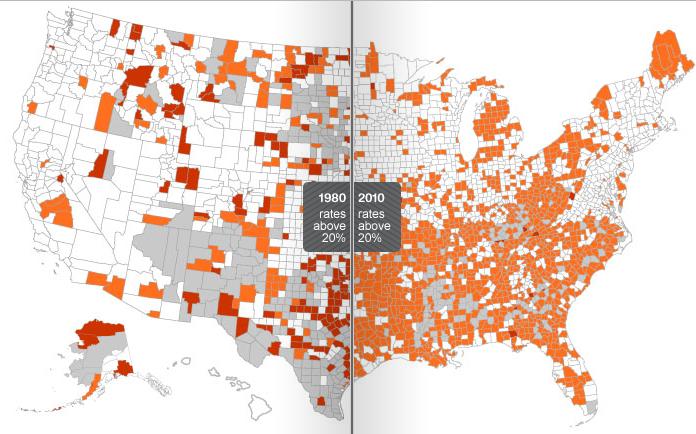
Click the link or image to see the interactive map

http://www.usatoday.com/news/graphics/2012/poverty-maps/index2.htm

Each map shows counties where the poverty rate is 20% or higher for kids or the elderly or for both. Use the slider to see how those patterns have shifted from 1980 to 2010.

Sources: Census Bureau data; Kenneth Johnson, University of New Hampshire, analysis by Paul Overberg, USA TODAY

By Jerry Mosemak and Chad Palmer, USA TODAY


Israels politics of discrimination – Israel News

Israels politics of discrimination – Israel News | Haaretz Daily Newspaper.

Israel’s politics of discrimination

How an informal process of decision making keeps Ashkenazi men at the top, while women, Arabs and Mizrahim are denied their fair share of power and resources.

By Eva Illouz Apr.25, 2012 | 4:58 PM  10
Illouz - Alon Ron - April 27, 2012
Meeting of university heads, 2008: One woman, Prof. Rivka Carmi, third from right, no Arabs.Photo by Alon Ron
THIS STORY IS BY

Discrimination is the sophisticated, less blunt, distant cousin of racism. It has the same effects as racism − ranking people by birth − without, necessarily, the same intentions, which is why discrimination is mostly and most often an invisible mechanism. This is also the reason why some legal provisions suggest evaluating discrimination on the basis of facts. But facts alone do not scrutinize the mindset of people working in organizations. If, for example, women represent 50 percent of the population, Arabs and Mizrahim constitute 60 percent of the population and if all three groups have almost never been represented among the rectors, presidents and deans, or been recipients of scientific awards of Israeli universities, we need not enter the minds of the people who make these decisions to suspect discrimination. The proof is in the famous pudding.

What is interesting − sociologically − about discrimination is that it produces racist or sexist effects without being necessarily connected to racist beliefs, at least not explicit ones. Universities and many cultural institutions are particularly good places to examine this phenomenon because they are full of liberal, well-intentioned, broad-minded people who want to promote equality, yet fail at it. Therefore, the question of how places full of liberal and broad-minded people end up being full of Ashkenazi men is puzzling. Here, gender and ethnicity should be viewed in similar terms, because mechanisms of exclusion in both cases are often similar ‏(with the proviso that Ashkenazi women are doing much better in Ashkenazi cultural institutions than Mizrahim and Arab men or women). Even if women and Mizrahim constitute large groups, each of these groups – despite their increasing visibility and presence in Israeli society – are still “minorities,” because historically they have been deprived of rights, privileges and resources that men have enjoyed. ‏(For example, when you understand the importance of the army for networking in many Israeli institutions, you realize why women and Arabs have been kept outside many centers of power.‏) In fact, we may go further: the “majority” that now controls so many institutions is largely made up of Ashkenazis ‏(among them a majority of men‏), and close to 60 per cent ‏(Arabs and Mizrahim‏) are the minorities left outside many centers of power. The fact that this situation has improved over time should not prevent us from asking why it is not improving faster.

Cultural capital

Inbal Bitton ‏(a fictional name‏) was born and raised in Kiryat Shmona. She went to a very mediocre school, where she learned a lot about Jewish holidays, the Holocaust, Zionism and the Torah, but very little about Athenian democracy, the difference between idealism and materialism in philosophy, the comparative study of the rationality at work in the Guide for the Perplexed and Arab civilization’s contribution to modern sciences. Still, thanks to her hard work, she studied at university, earned a degree in social work and geography, and now works in the urban planning department in the municipality of a large Israeli city. She is hard-working, meticulous, intelligent, and after a few years has become very competent at her job.

One day, she arrives at a meeting with the director of an international philanthropic organization who wants to contribute to the construction of public projects in Israel. In addition to the director, two other men are present; one grew up in Rehavia, the other in Haifa. The meeting gets off to a good start: The three men tell each other army jokes and learn that they have mutual acquaintances among the officers. The meeting progresses and some important decisions are made. At the end of the meeting, the three men stay on to chat; Inbal feels a bit of an outsider, so she politely leaves. During that final informal chat, the director of the philanthropic organization learns that he shares musical tastes with one of the other men, and that they both have a subscription to the Israeli Opera. One week later, the director of that same large philanthropic organization is asked by the Minister of Infrastructure to recommend someone for a prestigious position at his ministry that requires a great deal of experience in urban planning. Who do you think he will remember from the meeting held a week ago?

This fictional, yet realistic, anecdote serves to illustrate many phenomena all at once: Men do not exclude this woman because she is a woman, but because they can bond naturally − they all shared the same military humor, learned in the barracks. They do not exclude her because she is Mizrahi, but rather because all three of them grew up in similar Ashkenazi neighborhoods and could recognize in each other a common and similar style. In no way did they hold the a priori racist opinion that Mizrahim or people who grew up in Kiryat Shmona are less worthy than people who grew up in large urban centers. They simply inferred from her clothes, accent perhaps, last name, and her discomfort that she is not “sophisticated,” “representative” or “well-groomed.” Finally, in evaluating her style, the men confused two things: how competent she is at her job, and her “cultural capital” – how much high culture she knows and displays. They viewed cultural knowledge or capital as a sign of professional competence, which it is not.

The one who got the phone call was the one who also had a subscription to the opera. He got the call not because he was more competent in urban planning, but because he had the same upbringing, the same army experiences, the same way of speaking, the same manners, the same physical appearance, and the same musical taste as the one who called him. ‏(It also turns out that this style is congruent in general with the style of many who make important decisions‏.) This is, in a nutshell, the story of discrimination.

This anecdote says something important: much discrimination does not feel like discrimination at all; in fact, most of the time it feels like something else. It feels like the trust and respect we have for some and not for others; it feels like the bonds of camaraderie we create with others through the army, the university, the kibbutz, the youth group or the tennis club. Mostly it feels like an honest, objective evaluation of someone else’s competence and personality.

The reason why discrimination is so hard to fight, even in ourselves, is that it is very hard to identify because it happens behind our backs, so to speak − it almost always comes in the form of something else, like trusting someone from our group, or evaluating “objectively” someone as more competent or sophisticated, or preventing a “difficult” person from being promoted. In fact, quite often discrimination comes subtly packaged with qualities that many people value − such as being loyal to old friends; recognizing in others what makes us feel comfortable and on familiar terrain; promoting only “nice people,” those who do not question the privileges and entitlements we have. In the example above, discrimination is not a nasty and brutal way to exclude. It feels, and in some ways it is, natural and friendly. Nothing could be more natural than to be friendly to those who are like us and gentle to us.

Let me thus make a blunt sociological statement: What makes us feel good as members of a group usually plays out very badly in the overall politics of equality. Group cohesion does not go along with a capacity to integrate people who differ. A truly meritocratic society cannot be based on groups, because groups demand first and foremost loyalty, and loyalty is not an egalitarian or meritocratic virtue.
Nor does discrimination mean that we dislike members of minority groups ‏(this is where it differs from racism‏). In fact, women are liked so much that they are regularly discriminated against through courtship and sexual harassment in the workplace. Discrimination is a set of invisible strategies, the effect of which is to exclude minorities from available resources. Discrimination is about sharing power, not about our capacity to have women or Mizrahim or Arabs as friends, as lovers, or as our domestic workers. We can love Mizrahi women and discriminate against them in the workplace. The question of discrimination arises only when a man and a woman, a Mizrahi and an Ashkenazi, an Arab and a Jew, a native and a foreigner, are competing for the same resources, such as power, money, prestige, leadership.

How egalitarian are we?

To what extent a society allows its minorities to truly compete for resources with its majority is the true measure of how egalitarian it is. In modern democracies, education is the main channel for minorities to achieve social mobility. Therefore, education is a very important resource. For this reason, let us examine the position of women, Arabs and Mizrahim ‏(WAM‏) inside the institutions of the university. If you ask yourself why such cultural institutions as the university matter ‏(beyond the fact that this is the one I am most familiar with‏), it is for four reasons: 1‏) This institution is supposed to be entirely based on merit and merit alone; 2‏) as a public institution, it should be exemplary of values the entire society holds dear; 3‏) in a society based on educational mobility ‏(mobility through education‏), cultural leadership indicates a deeper form of social integration than that achieved through money and market mechanisms; and 4‏) because the university is by and large a well-managed organization, its failures are instructive of larger and more general processes.

Let me thus ask a simple question: Who sits on the faculty of Israeli universities? Prof. Nina Toren, who did pioneering research on this topic at the Hebrew University, found that in 2008, the academic staff of Israeli universities could be divided into three groups: 90 percent Ashkenazim; 9 percent Mizrahim ‏(with less than 2 percent Mizrahi women‏); 1 percent Arabs. Women constituted 27 percent of the entire academic body. This composition indicates that a structural discrimination exists, demonstrating that society is incapable of bringing representatives of 60 percent of its population ‏(Mizrahim and Arabs combined‏) into its universities as lecturers. Instead, most of the power is concentrated in the hands of Ashkenazi men.

These findings also suggest that ethnic discrimination is deeper and vaster than gender discrimination. Please note: Structural discrimination is not an intention to discriminate. It is de facto discrimination. But if this were the only explanation, one would expect that once women, Arabs and Mizrahim entered the gates of the university, they would be proportionately represented in the university leadership. Yet this is far from being the case. Proof that their exclusion is not “only” the result of structural flaws in the education system, but also stems from attitudes and biases actively present in the university, can be found in the following fact: If we make a very rough estimate of all the WAM across all Israeli universities who are already inside the university, all three groups would constitute 36 percent of the total number of lecturers. And yet, all together, they probably do not represent even 5 percent of the heads of academic institutions, people in significant positions of power and prestige in universities or research institutes, presidents of the Israel Academy of Sciences and Humanities, Israel Science Foundation, or national scientific committees. And this has been the case for many decades.
In the faculties of humanities and social sciences of many Israeli universities, even a middle-rank management position, like that of dean, has never been filled by a Mizrahi or an Arab, and almost never by a woman. The middle-rank position of director of the Institute for Advanced Studies at the Hebrew University has never been filled by a woman, a Mizrahi or an Arab. And on, and on, and on. It is difficult to imagine that in 60 years, all these institutions did not find one single woman, one single Mizrahi, one single Arab among those who were already inside the university, who was worthy of filling these relatively middle-rank positions, let alone the high-ranking ones. This clearly indicates that an informal process of decision making keeps WAM outside power and away from resources.

Think about this: WAM represent approximately 80 percent of the population, yet they do not represent even 5 percent of our academic elites. WAM are excluded not by any formal or concerted decision, but by a series of informal evaluations that concern either their professional competence or their personality. Universities and many cultural institutions make a particularly fertile terrain for this precisely because being a leader in these institutions is based on informal evaluations by others. ‏(This is why Mizrahim enter the business sector in droves, because success there is established by tangible performance, rather than informal evaluation by a group of Ashkenazi peers.) As Dr. Yofi Tirosh, a leading scholar of discrimination at the Tel Aviv University Faculty of Law, put it in a conversation for this article, the politics of discrimination is most visible in the politics of “representativeness” – that is, those chosen and perceived as “representative of the institution.” It is in the process of choosing someone who will represent the entire body that biases are widely used. The question is thus: How do such politics of representativeness operate on the ground?

Minorities’ dilemma

If you build a country by viewing Arabs and Mizrahim as culturally inferior, it is not difficult to understand how conditions are created for the formation of stereotypes of Arabs and Mizrahim as “not cultured, sophisticated or educated enough.” Stereotypes are not just routine associations of certain groups with specific attributes; they are powerful tools of social control. Stereotypes create expectations that some groups are fit or “unfit” for certain positions or activities.

Here is an example: In my opinion, one of the most brilliant minds in the Israeli public sphere today is an Arab man, Sayed Kashua. But Sayed Kashua has been able to succeed because he does not threaten anyone’s position in that field. He is an Arab man who writes about the relationships between Arabs and Jews. This is acceptable to a society based on Jewish control. If, however, Sayed Kashua had wanted to do research on modern Jewish history ‏(in the same way as Jews study the history of Islam or Christianity‏), it is a safe bet that things would have been more difficult for him. Why? Not because he would have had more power as a researcher of Jewish history, but because he would have been stepping out of a stereotype − that an Arab man can be a specialist only on Arab issues.

The point about stereotypes is that they create expectations about the kind and amount of territory a member of a minority is allowed to possess. As tools of social control, stereotypes also create expectations about who has the right to speak authoritatively to others. Stereotypes make the power of some seem natural and self-evident, while associating minorities with leadership and power seems much less natural. ‏(See, for example, all the interest generated by Prof. Rivka Carmi, president of Ben-Gurion University, precisely because it is very unusual for a woman to be president of an academic institution.‏) How comfortable do you think faculty members of the Hebrew University of Jerusalem, Tel Aviv University or the Weizmann Institute would be in choosing as their rector or president a Mizrahi man or an Arab woman?

An Ashkenazi man has the greatest sense of entitlement to lead and represent others, which is why it goes unnoticed when he does so. ‏(After Ashkenazi men, next in line in the hierarchy of entitlement are Ashkenazi women, then Mizrahim, and Arabs at the bottom − with a woman always having an inferior status to a man in any group.) More specifically, members of minorities are faced with the following dilemma, which has been documented in numerous experiments conducted by social psychologists: conforming to the image others have of them and being perceived as weak, or being perceived as competent and not being liked. This is undoubtedly the most common dilemma faced by minorities in the workplace.

One famous experiment conducted by Prof. Laurie Rudman from Rutgers University runs like this: You give two different groups of people ‏(composed of both men and women‏) the exact same story, with only one difference. One group reads a story with a male protagonist, while the other reads the same story with a female one. The story describes a highly successful professional. You then ask the people who read the story to evaluate the successful man or woman on a scale of competence ‏(how good at his/her job is s/he?‏) and likability ‏(how nice/caring do you think this person is?‏). The results are striking: Twenty years ago, the woman would have been rated as far less competent than the man; but today she is rated as equally competent ‏(feminism managed to change stereotypes about competence‏).

However, though she was found to be as competent as the man, she was also found to be significantly less likable, both by men and women. That is, the groups evaluating the protagonist − a highly successful professional − have exactly the same information about the man and the woman, yet the successful woman is deemed much less likable than the man.

Laurie Rudman ‏(and many other researchers‏) have conducted many experiments centering on this theme and found overwhelming evidence that women pay a heavy price for being perceived as powerful and competent, self-confident, assertive and self-reliant. When they rank high on competence, they are far more likely to rank low on what we expect them to be – namely, caring and group-oriented. Even though the experiment was done with women, we may hypothesize that it is true for other minorities as well. Minorities working in many organizations are confronted with the same dilemma of being either liked or viewed as competent. If they are liked, their likability comes from the fact that they correspond to the stereotype that associates them with weakness; when they deviate from the stereotype, they are perceived as boastful, lacking in a communal orientation to others, uncaring. In both cases − ranking low in competence or low in likability − they are not perceived as “representative” of the institution.

Let me now give you examples I have witnessed personally in many Israeli universities, in which the competence or likability of a member of a minority is evaluated in such a way that they end up being seen as unworthy to represent the institution ‏(examples come from all Israeli universities, which will make it impossible to identify the university or the characters involved‏).

Evaluating competence

1‏) “Moroccan accent”: A highly respected academic working in an Israeli university, an Ashkenazi male, tells me in a conversation that even though he knows he is being racist, he cannot take seriously a colleague of his, another professor, because of his “thick Moroccan accent.” Arabs’ speech is also heavily accented, and this accent is often felt to be unrepresentative of the group. People and the institution they work in cannot feel represented adequately by someone speaking with an accent. Ashkenazis, it should be said, have no less an accent than Mizrahim, but theirs is “unmarked” − it is not heard, precisely because Ashkenazis have established the norm of speech, which in turn becomes neutral.

2‏) “He’s so cute”: In an entirely different setting with entirely different characters, an Ashkenazi female listens to a colleague of hers who is delivering a scientific paper in a heavy Moroccan accent. She looks at him, shakes her head, and says ‏(they are both well past their 40s‏), “He is so cute, he is so cute, ‏(hamoud‏).” She did not mean she found him sexy; she meant he was so unthreatening that she found in him the attributes of a child. It is difficult to imagine her using this word for a male who projects authority and power. When the word hamoud, “cute,” is said to and of women in the workplace, it is often viewed as an insult, because cuteness is an attribute of children, which defuses the capacity to display power.

3‏) “Her field is too narrow”: Social hierarchy is reflected in the hierarchy of scientific fields. Mathematics, perhaps the scientific field with the highest prestige, has almost no women, Arabs or Mizrahim in it. Arabs and Mizrahim are absent from classics and medieval history, both fields which are far more valued than the more “political” fields that attract WAM. WAM tend to enter fields that are ranked lower in intellectual prestige, such as education, social work, sociology, political science or international relations. It is not surprising to find that there are far fewer recipients of scientific awards and large grants in the latter fields than the former.

The hierarchy of scientific fields reflects social hierarchy and is an indirect way of keeping resources in the same place. This social hierarchy also exists within fields. For example, a woman who studies “the experience of Mizrahi women in synagogues” is likely to be perceived as dealing with a narrower topic than a man studying “Kantian Rationality in the writings of Rabbi Soloveitchik” The first topic is perceived as “lower” and more narrow in the hierarchy of topics, because of its clearer association with a minority group.

4‏) “He is so cultured”: A large number of sociologists have claimed that cultural competence − the knowledge of “high,” European culture one is able to display − is often associated with greater status or prestige in cultural organizations. It therefore contributes to the informal ranking of people inside these organizations – not according to expertise in their topic, but according to their capacity to display the right membership in a specific social/ethnic class. Cultural competence is not only knowledge of high culture, but also of a specific way of speaking and expertise in a variety of informal domains, such as wine-tasting, patronizing operas and concert halls, developing a gourmet taste and cooking culture, traveling far and wide.

Sociologists have shown that high culture is often used not as a way to extend wisdom and cultivate aesthetics, but rather to display prestige, which is then used informally to increase one’s status inside an organization. Conversely, those who do not know how to display these informal attributes of status, often implicitly receive a lower ranking.